
What Makes MGO 850+ Manuka Honey Different From Regular Honey?
Honey has been enjoyed for centuries as a natural sweetener, but not all varieties have the same botanical origins, flavour or chemical composition. Among Australia’s premium honey varieties, Manuka Honey MGO 850+ stands out for its high methylglyoxal concentration and distinctive characteristics.
While regular honey is commonly used in cooking, baking and everyday drinks, Manuka honey is particularly recognised for its naturally occurring compounds and measurable MGO rating.
So, what makes MGO 850+ Manuka honey different from regular honey? The main differences involve its floral source, methylglyoxal concentration, antibacterial activity, production requirements and price.
Understanding these differences can help you choose the right honey for your preferences and everyday needs.
1. Different Floral Sources and Origins
One of the main differences between Manuka Honey MGO 850+ and regular honey is the nectar source.
Regular honey can be produced from numerous flowering plants, including eucalyptus, clover, orange blossom and other floral varieties. Each nectar source contributes to the honey’s natural flavour, colour and composition.
Australian Manuka honey, however, is produced when bees collect nectar from suitable plants belonging to the Leptospermum genus.
Australia is home to more than 80 native Leptospermum species, some of which can produce honey with substantial concentrations of methylglyoxal.
The Australian Manuka Honey Association has established scientific criteria for identifying authentic Australian Manuka honey, including its botanical origin and naturally occurring chemical markers.
This distinctive floral origin is one of the characteristics that separates Australian Manuka honey from conventional table honey.
2. MGO 850+ Contains a High Concentration of Methylglyoxal
The most important difference between MGO 850+ Manuka honey and regular honey is its measured methylglyoxal concentration.
Methylglyoxal, commonly known as MGO, is a naturally occurring compound associated with Manuka honey’s non-peroxide antibacterial activity.
An MGO 850+ rating indicates that the honey contains at least 850 milligrams of methylglyoxal per kilogram.
MGO develops from dihydroxyacetone (DHA), a compound found in the nectar of certain Leptospermum plants. As the honey matures, DHA can gradually convert into methylglyoxal.
Regular honey may also contain methylglyoxal, but it is not generally selected, graded or marketed according to a high MGO concentration.
This makes laboratory-tested MGO 850+ Manuka honey distinct from ordinary honey varieties.
3. Differences in Antibacterial Activity
All honey has characteristics that can make it difficult for certain microorganisms to grow. These include its high sugar concentration, low available water, acidity and, in many varieties, hydrogen peroxide activity.
Manuka honey has an additional characteristic: its methylglyoxal content contributes to non-peroxide antibacterial activity.
A scientific study published in PLOS ONE examined 80 Australian Leptospermum honey samples and identified a strong relationship between MGO concentration and non-peroxide antibacterial activity.
This helps explain why high-MGO Manuka honey has attracted significant scientific interest.
However, laboratory antibacterial activity does not mean that consuming Manuka Honey MGO 850+ will prevent infections or provide greater health benefits than regular honey.
It is also important to distinguish edible Manuka honey from specially prepared medical-grade honey products used in clinical wound care.
4. Manuka Honey MGO 850+ Has a Distinctive Flavour and Texture
Flavour is another noticeable difference between Manuka honey and many conventional honey varieties.
Regular honey can range from mild and floral to dark and robust, depending on the nectar collected by bees.
Australian Manuka honey often has a rich, earthy flavour with slightly herbal or caramel-like notes.
Its thick, smooth texture makes it suitable for enjoying straight from the spoon or adding to selected foods and drinks.
However, flavour, colour and consistency can vary naturally between harvests.
A darker colour or thicker texture does not necessarily indicate a higher MGO concentration. Laboratory testing is needed to establish the honey’s methylglyoxal level accurately.
5. Why Is MGO 850+ Manuka Honey More Expensive Than Regular Honey?
Manuka Honey MGO 850+ generally costs more than conventional honey because of its limited production, specialised harvesting requirements and high MGO concentration.
Leptospermum plants flower seasonally, giving bees a limited opportunity to collect nectar.
Unfavourable weather, changes in flowering patterns and variations in nectar availability can affect the quantity and characteristics of each harvest.
Not every Manuka honey harvest naturally produces honey that reaches MGO 850+.
Beekeepers must also consider suitable hive locations, colony health, harvesting conditions and laboratory testing.
Regular honey can be produced from a wider range of floral sources, allowing for greater production flexibility.
These differences help explain why high-MGO Australian Manuka honey is generally positioned as a premium product.
6. How Do Their Everyday Uses Compare?
Despite their differences, both Manuka Honey MGO 850+ and regular honey can be enjoyed as part of an everyday diet.
Regular honey is commonly used as a sweetener in tea, coffee, baking, marinades and desserts.
Manuka Honey MGO 850+ can be used in similar ways, although some consumers prefer to enjoy its distinctive flavour without combining it with too many other ingredients.
You can use Manuka Honey MGO 850+ in several simple ways:
-
Enjoy a small spoonful on its own.
-
Stir it into warm tea or milk.
-
Drizzle it over yoghurt, porridge or fresh fruit.
-
Add a small amount to smoothies or breakfast bowls.
Neither variety should be regarded as a sugar-free alternative. Manuka honey and regular honey both contain naturally occurring sugars and should be enjoyed in moderation.
7. How Can You Identify Authentic MGO 850+ Manuka Honey?
When purchasing premium Australian Manuka honey, checking the product information is more reliable than judging it by colour, taste or price alone.
Look for a clearly stated Australian origin, an MGO rating, laboratory testing information and transparent product details.
An MGO 850+ rating indicates a specific minimum methylglyoxal concentration, while additional quality checks can help verify the honey’s authenticity.
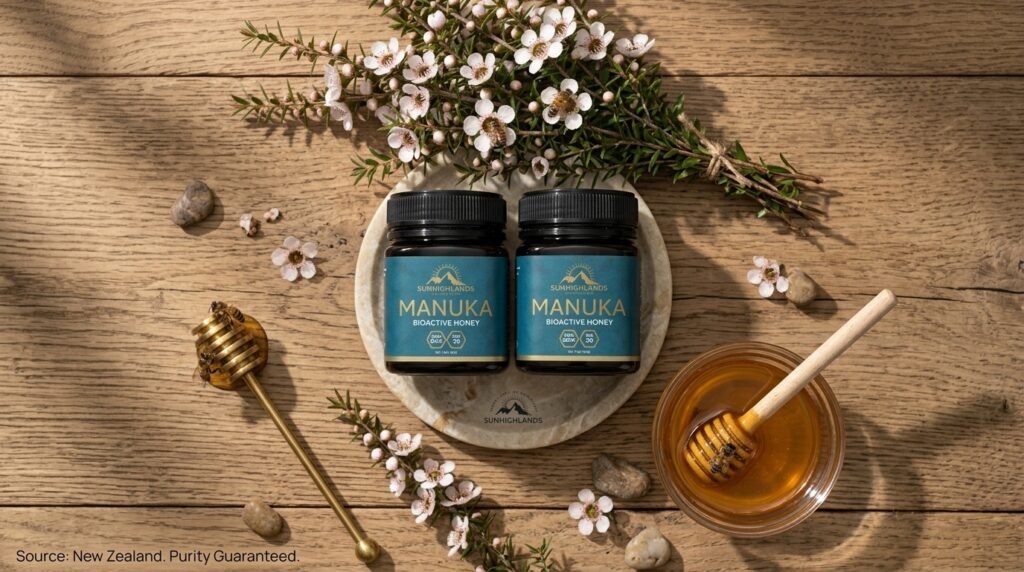
Sunhighlands Australia offers Australian Manuka Honey MGO 850+ in a 250g jar , with independent laboratory testing described in its product information.
Checking these details can help consumers make informed comparisons between different honey products.
Frequently Asked Questions
Is MGO 850+ Manuka honey stronger than regular honey?
MGO 850+ Manuka honey has a high measured methylglyoxal concentration associated with non-peroxide antibacterial activity. This does not mean it provides greater medical benefits when consumed.
Can I replace regular honey with Manuka Honey MGO 850+?
Yes. Manuka Honey MGO 850+ can be used as a sweetener in drinks, breakfast foods and everyday recipes where you would normally use honey.
Does regular honey contain MGO?
Regular honey may contain methylglyoxal, but it is not generally characterised by the high MGO concentrations associated with premium Manuka honey.
Is Manuka Honey MGO 850+ suitable for daily consumption?
Yes. It can be enjoyed in moderation as part of a balanced diet. Like regular honey, it contains naturally occurring sugars.
Can babies consume Manuka Honey MGO 850+?
No. Like all honey, Manuka honey should not be given to babies under 12 months because of the risk of infant botulism.
Conclusion
The main differences between Manuka Honey MGO 850+ and regular honey are their botanical origins, methylglyoxal concentrations, distinctive flavours, production requirements and retail prices.
Regular honey remains a versatile choice for everyday sweetening and cooking, while MGO 850+ offers a measurable methylglyoxal concentration and the characteristic flavour of Australian Manuka honey.
Understanding these differences, along with the importance of product authenticity and laboratory testing, can help you decide which honey best suits your preferences and budget.