
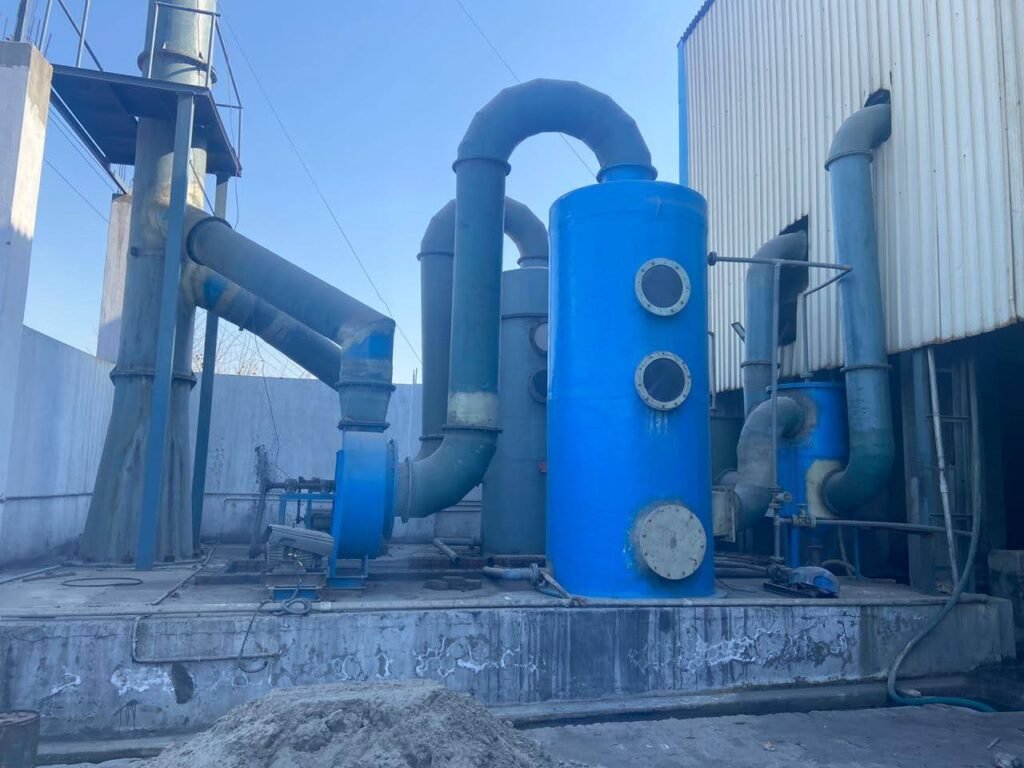
GPT-INDIA Dust Collection System: Improving Industrial Air Quality Through Smarter Pollution Control
Industrial air pollution control is not simply about installing a filter or placing an exhaust fan near a machine. Every manufacturing process creates a different combination of airborne contaminants, and the right solution depends on what is released, how much is generated, and where it travels. Dust from material handling, fumes from production equipment, and gases from chemical processes require different control strategies.
A well-planned Dust collection system helps manufacturers capture particulate matter before it spreads throughout the facility. Where the process also produces chemical gases, vapours, or certain liquid-borne contaminants, a Wet Scrubber or another suitable treatment technology may be required. The challenge is to select equipment that works with the process instead of treating every emission as the same problem.
GPT-INDIA, also known as Green Planet Technologies, works in industrial air pollution control, ventilation, and exhaust technology. For businesses planning a new installation or improving an existing factory, understanding source capture, treatment selection, airflow, and maintenance is an important step towards reliable air pollution control.
Why a Dust Collection System Should Be Designed Around the Process
Dust is generated in many ways during industrial production. Cutting, grinding, sanding, mixing, crushing, conveying, and material transfer can all release airborne particles. The quantity and characteristics of this dust vary according to the raw material, machinery, production rate, and operating conditions.
A suitable Dust collection system captures dust near the point where it is generated and transports it through ductwork to an appropriate collection unit. Depending on the application, the equipment may use fabric filtration, cyclone separation, or another suitable particulate-control method.
Source capture is important because dust becomes harder to control after it spreads across a large area. When an extraction hood is positioned correctly, contaminated air can be drawn into the system before the particles disperse widely. This can help reduce deposits on machinery, limit housekeeping requirements, and support better control of workplace air.
However, the collector alone does not determine the result. Hood placement, duct dimensions, airflow, filter selection, fan performance, and dust discharge all influence the effectiveness of the installation. A system designed without considering these elements may consume energy without providing the required capture performance.
For that reason, manufacturers should begin by identifying the dust-generating processes, the number of machines operating at once, and the required extraction conditions.
How to Select the Right Dust Collection Technology
Different particulate-control technologies suit different applications. A fabric filter, for example, separates dust by passing the contaminated air through filter media. As particles accumulate, the filter requires cleaning or replacement according to its design and operating conditions.
Cyclone-based equipment separates suitable particles using centrifugal action. It can be useful for certain dust streams, including applications where the material characteristics make cyclone separation appropriate. In some installations, cyclone equipment is considered as a preliminary collection stage before finer filtration.
The correct choice depends on particle size, dust concentration, temperature, moisture, abrasiveness, and the required outlet performance. Sticky or moisture-sensitive material may create problems for equipment designed for dry dust. Similarly, combustible dust requires an assessment of the material and the relevant fire and explosion risks before the collection system is selected.
Airflow calculations are equally important. The system needs to provide sufficient capture at the connected machines while accounting for the resistance created by ducts, bends, dampers, and filters. If several machines operate simultaneously, their airflow demands must be evaluated as part of the overall design.
Manufacturers should also consider how collected dust will be removed. Hoppers, discharge valves, containers, and downstream material-handling equipment must be compatible with the type and quantity of material collected. A reliable installation treats collection, filtration, and discharge as connected functions.
When Does a Wet Scrubber Make Sense?
A Wet Scrubber brings a contaminated gas stream into contact with a liquid, commonly water or a purpose-selected scrubbing solution. Depending on its design and the chemistry involved, it can remove suitable particulate matter or absorb particular gaseous pollutants.
This makes wet scrubbing relevant to certain chemical-processing operations, surface-treatment processes, and industrial applications where dry collection alone is not sufficient. The technology can also be considered where the characteristics of the contaminant make liquid-based treatment suitable.
Not every Wet Scrubber is designed for the same duty. A spray tower, packed-bed scrubber, and venturi scrubber operate differently and may suit different contaminants and performance requirements. The design must reflect the required gas-liquid contact, the inlet pollutant concentration, and the expected outlet quality.
The US Environmental Protection Agency explains that wet scrubber performance for particulate control is closely related to the energy used to bring the gas stream into contact with the scrubbing liquid. Its guidance also identifies liquid flow, pressure differential, and other operating parameters as important monitoring considerations.
For gaseous pollutants, the chemistry of the contaminant and the scrubbing liquid becomes particularly important. A system that works for one gas cannot automatically be expected to treat another. The equipment should be selected using process information rather than relying on a general description such as fumes, odour, or chemical emissions.
What to Discuss With Wet Scrubber Manufacturers
When evaluating Wet Scrubber manufacturers, begin with the actual treatment requirement. The supplier needs to understand the type of pollutant, its concentration, gas flow rate, temperature, moisture conditions, and the quality required at the outlet.
The scrubbing liquid must be suitable for the contaminant. Some applications may require a chemical solution, while others may use water or a different liquid arrangement. Where recirculation is used, the design should account for liquid quality, accumulated solids, blowdown, and disposal or treatment of the resulting wastewater.
Materials of construction deserve careful consideration. Corrosive gases, chemicals, moisture, and temperature can affect the scrubber body, internal components, piping, pumps, and seals. Material selection should reflect the expected operating environment and the chemicals present.
The proposed system should also include a practical approach to monitoring and maintenance. Operators may need to track liquid flow, pressure differential, and other process-specific indicators. A change in these parameters can point to a blocked nozzle, inadequate liquid circulation, scaling, or another issue requiring investigation.
Manufacturers should explain how the equipment can be inspected, cleaned, and serviced. They should also clarify the operating conditions for which the system has been designed and how performance can be verified after commissioning.
Choosing Wet Scrubber Suppliers for Long-Term Operation
Comparing Wet Scrubber suppliers involves more than comparing equipment prices. The initial purchase cost is only one part of the overall investment. Liquid consumption, pumping requirements, fan energy, maintenance labour, corrosion protection, and wastewater management may also influence long-term operating costs.
A useful supplier discussion should cover the complete installation. The scrubber’s pressure drop affects the fan or blower selection, while the duct network influences the airflow delivered to the treatment equipment. If a mist eliminator is required, it must be suitable for the process and accessible for inspection.
Ask how the system will perform when production conditions change. Some factories experience variations in gas flow or pollutant concentration throughout the day. The treatment arrangement should be assessed against the expected operating range rather than only one ideal condition.
It is also worth discussing the availability of replacement parts, access to service support, operating documentation, and recommended inspection intervals. These practical details help plant teams plan maintenance and respond more quickly when performance changes.
The most suitable supplier is one that understands the application and can explain why the proposed design fits the actual process requirements.
Fume Extraction System: Capture Contaminants Before They Spread
A Fume extraction system is designed to capture and convey contaminated air from processes that generate fumes, smoke, vapours, or other airborne pollutants. Examples may include welding, heating, metal processing, chemical handling, and certain surface-treatment operations.
Effective extraction generally begins near the source. A capture hood, extraction arm, enclosure, or purpose-designed inlet draws contaminated air into the system before it spreads through the workplace. The air is then transported through ductwork towards the required filtration, treatment, or exhaust arrangement.
The type of contaminant determines what happens next. Particulate fumes may require suitable filtration, while certain gaseous pollutants may need wet scrubbing or another gas-treatment technology. Some applications involve several contaminants and require more than one treatment stage.
A Wet Scrubber should not automatically be treated as a complete solution for every fume stream. Its effectiveness depends on the pollutant and the treatment chemistry. Likewise, a dust collector is not a universal substitute for gas treatment.
A well-designed extraction system must also consider the fan, duct resistance, capture position, make-up air, and exhaust discharge. These elements work together to determine whether contaminated air is captured and transported as intended.
How Dust Collection and Wet Scrubbing Can Work Together
Some factories generate both particulate matter and gaseous contaminants, but this does not mean that every process should use a single combined unit. The treatment sequence should be based on the nature of each emission and the compatibility of the equipment.
For example, a facility may use a dedicated dust collector for a dry material-handling operation and a separate Wet Scrubber for a suitable gas-treatment process. In another application, an engineered combination of treatment stages may be considered if the inlet contaminants and operating conditions support it.
The key is to understand the role of each stage. Particulate collection removes suitable airborne solids. Wet scrubbing transfers selected pollutants from a gas stream into a liquid. Fume extraction captures and conveys contaminated air from its source. These functions are related, but they are not interchangeable.
Where multiple stages are required, engineers should consider pressure losses, fan performance, moisture carryover, corrosion, waste handling, and the possibility of one stage affecting the next. The final arrangement should be evaluated as a complete system.
This process-based approach helps manufacturers avoid investing in equipment that is technically unsuitable for the contaminant or difficult to maintain under real production conditions.
Maintenance Practices That Help Preserve Performance
Even a well-designed pollution-control installation requires routine inspection. Dust collectors may experience changes in filter resistance, damaged filter media, air leakage, or problems with dust discharge. Wet scrubbers can experience low liquid flow, blocked nozzles, scaling, corrosion, or poor liquid distribution.
Operators should know which operating parameters need to be checked and what constitutes an unusual change. For a Wet Scrubber, monitoring pressure differential and liquid flow can help identify some problems before they significantly affect performance. The exact parameters and acceptable ranges should be established for the specific equipment and operating conditions.
For dust collection, maintenance may include inspecting filters, checking the cleaning mechanism, reviewing fan operation, and ensuring that the collected material can be discharged properly. For fume extraction, hood position, duct condition, and airflow should be reviewed, especially after changes to machinery or production layout.
Records of inspections, repairs, filter changes, and operating readings can help identify recurring problems. If a system repeatedly loses performance, the cause should be investigated rather than replacing individual components without understanding the underlying issue.
Maintenance planning is most effective when it follows the manufacturer’s instructions and reflects the actual duty of the installation.
GPT-INDIA Industrial Air Pollution Control Solutions
GPT-INDIA, also known as Green Planet Technologies, works in industrial air pollution control, dust collection, ventilation, and exhaust technology. Its product range includes dust collection equipment, Wet Scrubbers, fume extraction solutions, and other industrial air management systems.
For a new project, the selection process should begin with the production details. Manufacturers should identify the source of the emissions, the pollutant characteristics, required airflow, operating temperature, expected production schedule, and available installation space.
For an existing plant, a review of the current system can help establish whether poor performance is related to capture design, duct resistance, filter condition, liquid circulation, or changing process conditions. This can support a more informed decision about maintenance, modification, or replacement.
GPT-INDIA can be approached to discuss industrial dust collection and air pollution control requirements based on the specific application. The aim should be to select equipment that meets the process need and remains practical to operate and maintain.
GPT-INDIA NAP Details
Green Planet Technologies (GPT-INDIA)
Office Address: 59/2/1, Site 4, Industrial Area, Sahibabad, Distt. Ghaziabad–201010, Uttar Pradesh, India
Phone: +91-9773500660
Email: info@gpt-india.com
For product information, visit the official GPT-INDIA website and discuss your industrial dust collection, fume extraction, or gas-treatment requirements with the company.
Frequently Asked Questions
What is a Dust collection system used for?
A Dust collection system captures and removes suitable airborne particulate matter from industrial processes. It typically includes collection hoods or inlets, ductwork, a collection unit, a fan, and a method for removing the collected material.
What is the difference between dust collection and wet scrubbing?
Dust collection commonly uses filtration or mechanical separation to remove particulate matter. A Wet Scrubber uses contact between a contaminated gas stream and a liquid to capture suitable particles or absorb certain gaseous pollutants. The correct choice depends on the contaminants and required treatment result.
How do I choose between Wet Scrubber manufacturers?
Compare technical suitability, materials of construction, expected treatment performance, liquid circulation, pressure drop, monitoring, maintenance access, and wastewater handling. Provide accurate process information before asking for a system recommendation.
What should I ask Wet Scrubber suppliers before purchasing?
Discuss the pollutant composition, gas flow, temperature, required outlet quality, liquid chemistry, pressure drop, operating costs, maintenance schedule, and treatment of used liquid or sludge. Confirm how performance will be monitored.
When is a Fume extraction system required?
A Fume extraction system is considered when a process releases fumes, smoke, vapours, or other airborne contaminants that need to be captured and conveyed away from the source. The extraction and treatment method depends on the specific emission.
Can one system remove every type of industrial pollutant?
No. Dust, liquid droplets, and gaseous contaminants have different physical and chemical properties. A facility may require separate equipment or multiple treatment stages, selected according to the pollutant and operating conditions.
Conclusion
Effective industrial air pollution control starts with understanding the process and identifying the contaminants that need to be captured or treated. A Dust collection system is suitable for controlling appropriate particulate streams, while a Wet Scrubber can address selected particles or gaseous pollutants through liquid-based treatment. A Fume extraction system captures contaminated air near its source and directs it towards the appropriate treatment stage.
Selecting equipment on the basis of process conditions, airflow, maintenance requirements, and treatment objectives helps manufacturers make more informed investment decisions. GPT-INDIA provides industrial air pollution control and extraction solutions for businesses evaluating these needs. A properly planned system can support more consistent operations, practical maintenance, and a more controlled industrial environment.