
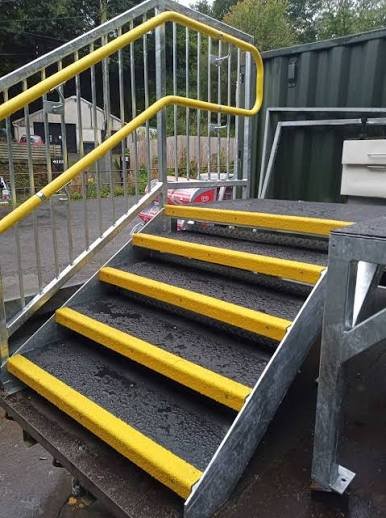
Comprehensive Guide to GRP Stair Nosing for High-Traffic Industrial & Commercial Safety
Industrial facilities, commercial hubs, and high-footfall venues face continuous challenges in maintaining stair safety and compliance. Staircases in warehouses, manufacturing plants, commercial kitchens, and public buildings are subject to relentless operational wear. Over time, edges chip, smooth down, and become hazardous slip hazards, particularly when moisture, oil, or debris accumulates. Implementing robust step edge covers is essential to protect structural integrity and prevent costly slip, trip, and fall incidents across UK facilities.
Glass Reinforced Plastic, commonly known as GRP, has emerged as one of the most resilient materials for structural edge protection. Combining high strength-to-weight ratios with exceptional corrosion and impact resistance, GRP step covers provide immediate traction enhancement in severe environments. Understanding the material properties, load capabilities, and installation requirements of grp stair nosing helps safety officers, warehouse managers, and facility executives implement long-term risk reduction strategies that satisfy stringent UK health and safety regulations.
The Biomechanical and Structural Risks of Unprotected Stair Edges
Stairway dynamics impose distinct kinetic forces on human joints and step substrates. During descent, a person’s entire body weight, combined with gravitational acceleration, concentrates on the leading edge of the stair tread. If that edge lacks sufficient friction or structural support, foot slippage occurs instantly, offering zero opportunity for recovery.
In industrial settings, step degradation occurs rapidly under foot traffic carrying heavy equipment or tools. Concrete corners crack and spall into fine grit, timber edges wear round, and steel open-grating treads polish down until they offer virtually no traction. Environmental contaminants like water, oil, food fats, or airborne dust exacerbate the danger by forming a slippery barrier between footwear soles and step surfaces. Installing high-traction composite nosings restores flat, high-friction landing points that stabilize foot placement and significantly lower fall risks.
Core Material Properties of Glass Reinforced Plastic (GRP)
GRP is a composite material formed by embedding glass fiber reinforcement within a thermosetting resin matrix. This manufacturing process produces a rigid component capable of handling extreme mechanical stress without rusting, cracking, or degrading.
-
Exceptional Corrosion Resistance: Unlike steel or aluminium, GRP is completely immune to rust, salt spray, chemical spills, and standing water, making it ideal for coastal, chemical, or outdoor UK industrial facilities.
-
High Impact & Flexural Strength: The integrated glass fiber matrix absorbs heavy impacts from dropped tools or pallet movement without denting or deforming out of shape.
-
Embedded Anti-Slip Grit: Quartz or silicon carbide grit is woven directly into the resin surface during production, creating a coarse, non-wear slip-resistant finish that will not peel or flake off over time.
-
Thermal & Electrical Non-Conductivity: GRP does not conduct electricity and remains thermally stable across extreme temperature shifts, serving as a safe choice around high-voltage equipment or frozen storage areas.
Safety personnel seeking specialized edge protection for heavy-duty operational sites can explore tailored options directly via the main Anti Slip Stair Nosing portal.
Material Comparison: GRP vs. Traditional Stair Nosing Options
Selecting the right stair edge reinforcement requires evaluating performance characteristics across different materials under demanding operational conditions.
| Material Type | Corrosion Resistance | Impact & Wear Resistance | Slip Resistance (Wet/Oily) | Electrical Conductivity | Typical Lifespan |
| GRP Composite | Excellent (Rust-Proof) | Superior | Extremely High | Non-Conductive | 15–20+ Years |
| Aluminium | High (Oxidizes slightly) | High | High (with inserts) | Conductive | 15–20 Years |
| Solid Brass | Moderate | High | Moderate | Conductive | 15+ Years |
| PVC / Vinyl | High | Low to Moderate | Moderate | Non-Conductive | 3–7 Years |
Profile Selection and Visual Contrast Requirements
Selecting effective GRP step edge covers requires careful attention to dimensions, grit grain sizes, and visual accessibility standards. In the UK, building regulations mandate clear visual contrast on stair edges to assist individuals with visual impairments. High-visibility yellow or white GRP edges contrast sharply against darker concrete, asphalt, or metal treads, defining the step margin clearly even in dimly lit stairwells or emergency evacuation paths.
Grit density must also match the operational environment. Coarse, heavy-industrial grit profiles excel on outdoor escape routes, wet processing plants, and marine docks where thick-soled work boots require maximum bite. Medium or fine grit options suit indoor commercial spaces where footwear varies and ease of cleaning is a priority.
To review detailed specifications, profile dimensions, and color contrast configurations, facility managers can check the specialized range at grp stair nosing for technical floor compliance.
Installation Methods for Long-Term Durability
The operational lifespan of a GRP nosing depends directly on the quality of its installation. A dual-fix method combining mechanical fasteners with high-tack structural adhesive yields the strongest, most enduring bond across all major substrates.
-
Surface Preparation: Clean the step substrate thoroughly to remove oil, grease, dirt, and loose aggregate. Concrete surfaces should be dry and dust-free; metal surfaces should be wire-brushed or degreased.
-
Adhesive Application: Apply a continuous bead of polyurethane or epoxy structural adhesive along the underside of the GRP profile. This fills minor surface irregularities and prevents water from trapping under the cover.
-
Mechanical Fastening: Drill pilot holes through the pre-drilled GRP profile into the stair substrate. Secure the cover using countersunk stainless steel screws and masonry plugs for concrete, or self-tapping screws for metal grates and steel plates.
-
Finishing: Ensure all screw heads rest flush with the surface grit to eliminate trip points, and wipe away excess adhesive along the back edge for a neat finish.
Frequently Asked Questions
What makes GRP stair nosing ideal for outdoor industrial stairs?
GRP is entirely rust-proof, weather-resistant, and impervious to frost, salt, and rainwater, ensuring long-term structural integrity and high slip resistance on external metal or concrete steps.
How does GRP compare to aluminium stair nosing in chemical environments?
GRP offers superior resistance to chemical spills, acids, and alkalis because resin matrix composites do not corrode or pit when exposed to harsh industrial chemicals, unlike metal alloys.
Can GRP stair nosing be installed over damaged concrete step edges?
Yes. Pre-formed GRP profiles span across chipped or cracked concrete corners, encapsulating the damaged area and providing a smooth, level, non-slip edge without immediate concrete reconstruction.
Is GRP stair nosing suitable for high-voltage or electrical facilities?
Yes, GRP is non-conductive and spark-proof, making it a safe choice for electrical substations, power plants, and hazardous chemical environments.
How do I clean and maintain GRP anti-slip stair covers?
Regular sweeping with a stiff-bristled broom and washing with mild industrial detergents or pressure washers keeps the embedded aggregate clean and free of oil or debris build-up.
Does GRP stair nosing meet UK visual contrast standards?
Yes, GRP nosings are available in vibrant safety colors such as safety yellow and bright white, providing high visual contrast to satisfy UK DDA and building safety regulations.
Can GRP nosing be fitted onto metal checker plate stairs?
Yes, GRP nosing can be anchored directly onto metal checker plate or open mesh steel steps using stainless steel bolts, self-tapping screws, or specialized grating clips.
How long does GRP stair nosing typically last in heavy-traffic sites?
In high-footfall industrial warehouses and public venues, high-quality GRP nosing commonly lasts 15 to 20 years or more without losing its anti-slip properties or structural strength.