
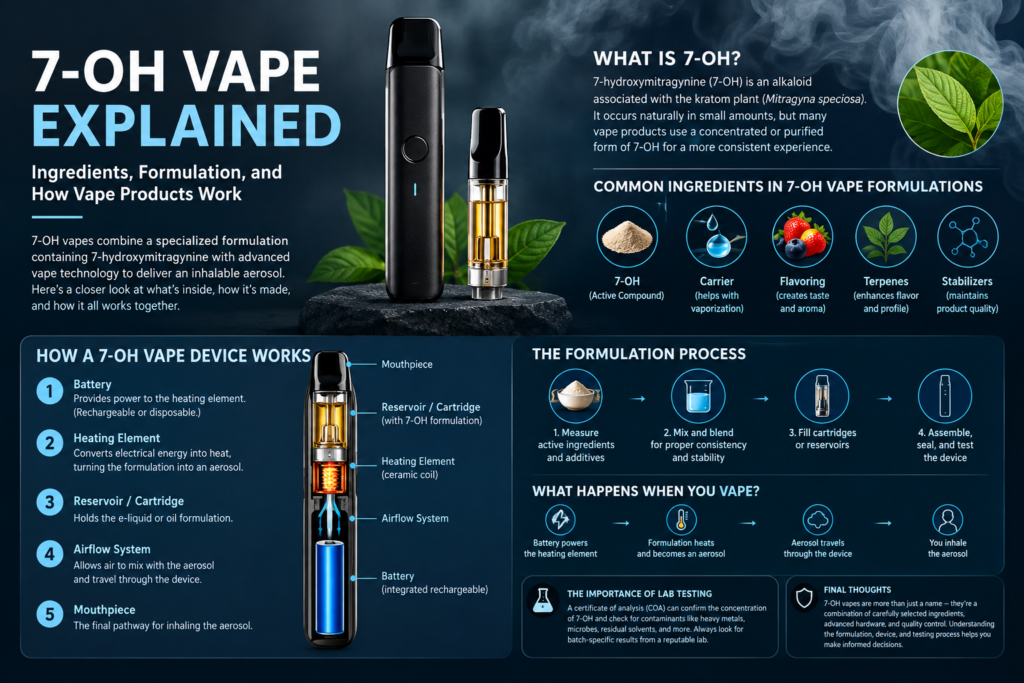
7-OH Vape Potency Guide: Understanding Strength, Concentration, and Product Labels
7-OH vape products can vary considerably in their formulation, concentration, hardware, and labeling. For anyone researching these products, understanding what “potency” actually means is more useful than relying on marketing language alone.
The term 7-OH generally refers to 7-hydroxymitragynine, an alkaloid associated with the kratom plant. In vape products, it may be presented as part of a formulated liquid or extract intended for use with a vaporizer or disposable device.
Because products can differ in concentration and total contents, the information printed on the package matters.
What Does Potency Mean in a 7-OH Vape?
Potency can refer to the concentration of a particular ingredient within a product or the total amount of that ingredient contained in the entire device.
These are not necessarily the same measurement.
For example, a label may provide information in terms of:
- Milligrams per gram
- Milligrams per milliliter
- Total milligrams per device
- Percentage by weight
- Concentration of an active ingredient
A product containing a certain number of milligrams in the entire cartridge is describing total content, while a measurement such as milligrams per milliliter describes concentration.
Understanding this distinction helps prevent comparisons between products that use different labeling formats.
Total Content vs. Concentration
Consider two hypothetical products.
Product A contains a specified amount of 7-OH in a 1 mL cartridge. Product B contains the same total amount distributed across a larger volume.
Although the total amount may be similar, the concentration can differ.
This is why simply comparing numbers printed prominently on packaging does not always provide a complete picture.
When comparing products for informational purposes, look for both the total amount and the concentration, if they are provided.
Why Product Size Matters
Device size can affect how label information should be interpreted.
A disposable vape may contain a specific volume of liquid, while another product may contain a larger reservoir. A larger device does not automatically mean a higher concentration of its active ingredients.
The label should ideally identify:
- Liquid volume
- Total active ingredient content
- Ingredient concentration
- Batch or lot number
- Manufacturer or brand information
- Testing information
- Date or production information where applicable
This information provides more context than the device size alone.
Understanding Percentage Labels
Some products use percentages rather than milligram measurements.
A percentage generally describes how much of a particular substance is present relative to the total formulation. However, the meaning depends on how the manufacturer defines the measurement.
A percentage may refer to weight concentration, volume concentration, or another specification.
For this reason, consumers should avoid assuming that two products with the same percentage necessarily contain identical total quantities.
The units and testing documentation are important.
What Is a COA?
A Certificate of Analysis, commonly abbreviated as COA, is a laboratory document associated with a particular product or batch.
A COA may provide information about:
- Tested compounds
- Measured concentrations
- Contaminant screening
- Microbial testing
- Heavy metals
- Residual solvents
- Laboratory identification
- Batch or lot information
A laboratory report is more useful when it can be connected to the exact product or batch being sold.
Why Batch Information Matters
Formulations can change between production runs. If a product has a batch number, that number can help connect the physical product with its corresponding laboratory documentation.
When reviewing testing information, check whether the batch number on the product corresponds with the batch number listed on the report.
A generic laboratory document without clear product or batch identification provides less information about the specific item being considered.
Potency Claims vs. Verified Measurements
Words such as “strong,” “high potency,” or “extra strength” are marketing descriptions rather than standardized scientific measurements.
They do not necessarily tell you how much 7-OH is actually present.
A more useful approach is to look for measurable information such as:
Total 7-OH content → concentration → product volume → batch information → laboratory results
This gives a clearer picture of what the label is actually describing.
Does the Device Type Affect Potency?
The device itself does not necessarily determine the concentration of 7-OH in the liquid.
A disposable, cartridge, or refillable device can contain different formulations.
However, hardware can affect characteristics such as:
- Heating method
- Airflow
- Reservoir size
- Temperature control
- Coil or heating element
- Battery configuration
These hardware differences can influence how a formulation is vaporized, but they should not be confused with the chemical concentration of the product.
Reading a 7-OH Disposable Vape Label
A useful label-reading process starts with the basic product information.
First, identify the product name and manufacturer. Then check the stated liquid volume and ingredient information.
Next, look for a stated amount or concentration of 7-OH.
After that, locate the batch or lot number and any testing reference.
If a COA is provided, compare the information on the report with the information printed on the product.
This process is more reliable than judging a product based on packaging design or descriptive terminology.
Final Thoughts
Terms such as “high potency” are not substitutes for measurable specifications.
For a clearer assessment of a product’s composition, focus on the ingredient declaration, units of measurement, batch identification, and corresponding laboratory documentation. This makes it easier to understand what the product label is actually communicating.