
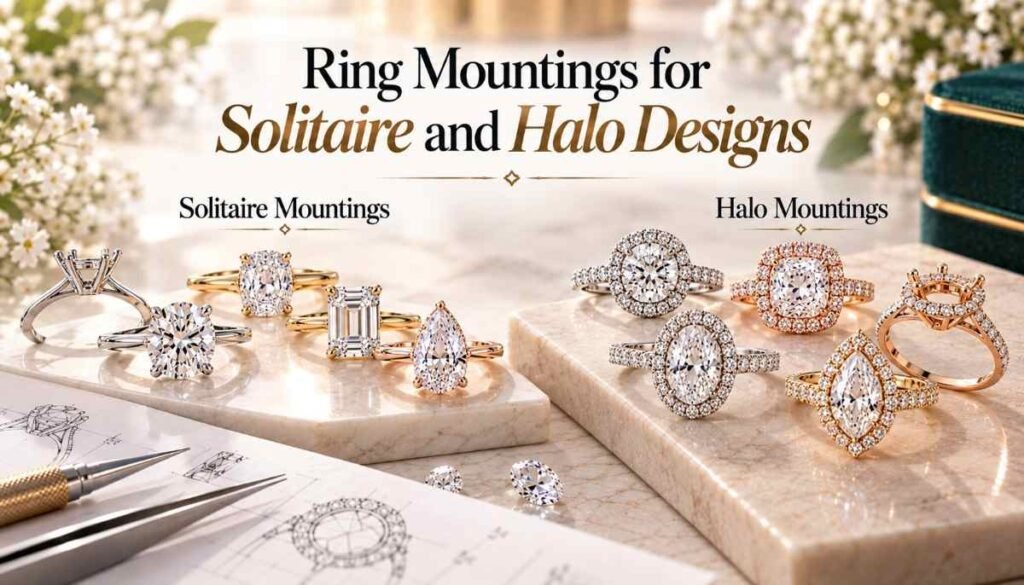
Ring Mountings for Solitaire and Halo Designs
Solitaire and halo are the two most requested ring design styles in the jewelry business, and for good reason. One celebrates a single stone with nothing to compete for attention; the other amplifies a center stone with a surrounding ring of brilliance. But while they might look like two variations on the same idea, the mountings behind them are engineered quite differently, and sourcing the right ones requires understanding what each design demands from a structural and craftsmanship standpoint. This guide looks at ring mountings for both solitaire and halo designs, covering what makes each one work, where the engineering differences lie, and what jewelers should prioritize when stocking them.
The Appeal of Solitaire Mountings
A solitaire mounting features a single center stone with no accent of diamonds, relying entirely on the quality of the stone and the elegance of the setting to carry the design. This simplicity is exactly why solitaires have remained a staple of engagement ring design for generations. There’s nowhere for a poorly made setting to hide, which means craftsmanship quality is on full display. Solitaire mountings appeal to customers who prefer timeless, understated elegance, and they tend to work with virtually any center stone shape, from round and oval to emerald and pear. They also offer the most straightforward path to resizing and repair, since there’s minimal additional detailing to work around.
Engineering Priorities for Solitaire Mountings
Because a solitaire design is so minimal, a handful of structural details carry outsized importance. Prong precision. With only the center stone to look at, prong height, spacing, and symmetry are immediately noticeable. Uneven prongs are one of the first things a trained eye will catch in a solitaire. Basket and gallery construction. The metalwork beneath the stone, often visible from the side, needs to be cleanly finished and structurally sound. Cathedral-style solitaires, where the band sweeps upward to meet the head, require particularly precise joining to stay durable. Shank integrity. Many solitaire bands are fairly slender, which makes metal thickness and finishing quality especially important for long-term durability. Stone-size tolerance. For semi-mount solitaires in particular, the setting needs to accommodate small variations in center stone dimensions without requiring extensive rework at the setting stage.
The Appeal of Halo Mountings
Halo mountings surround the center stone with a circle of smaller accent diamonds, creating added sparkle and making the center stone appear larger than its true carat weight. This visual lift is a big part of why halo settings have remained so consistently popular, particularly for customers who want a bold, eye-catching look within a specific budget. Halo designs also pair beautifully with a wide range of center stone shapes. Oval and pear stones take a dramatic elongated look inside a halo; cushion cuts lean into a softer, vintage-inspired feel, and round stones gain a classic, glamorous finish.
Engineering Priorities for Halo Mountings
Halo mountings are structurally more complex than solitaires, and engineering demands reflect that. Accent stone setting precision. A halo involves dozens of tiny stones, each requiring secure, evenly positioned prong or bead settings. Inconsistent spacing or uneven stone height is immediately visible and undermines the whole design. Halo-to-center-stone proportion. The halo needs to be sized correctly relative to the center stone, too thin, and it looks like an afterthought, too thick, and it overwhelms the center stone entirely. Structural support beneath the halo. The metal framework supporting the halo needs to be strong enough to hold the accent stones securely through years of wear, while still looking delicate from above. Cleaning accessibility. A well-engineered halo should allow reasonable access for cleaning around the accent stones, since poorly designed crevices trap dust and oils more readily and dull the overall sparkle faster. Resizing compatibility. When pavé detailing extends along the shank, the mounting needs to be constructed so that resizing doesn’t disrupt that detailing, a design detail that’s easy to overlook until a customer needs a size adjustment.
Comparing Solitaire and Halo from a Sourcing Perspective
From a jeweler’s perspective, the two styles carry different sourcing implications. Solitaire mountings tend to be simpler and often more cost-efficient to produce, which makes them a strong foundation for the entry-level and mid-range portions of a catalog. Their simplicity also means quality differences between manufacturers become much more visible, so choosing a supplier with consistent craftsmanship matters more than it might for a more heavily detailed design where small imperfections can hide. Halo mountings, by contrast, command a higher price point and attract customers who want more visual impact, but they demand much greater technical precision from the manufacturer. A halo mounting that looks beautiful in a catalog photo but has uneven accent stone placement or weak prong support in person is a liability, generating returns and damaging customer trust.
Building a Balanced Catalog Across Both Styles
Most successful jewelers don’t choose between solitaire and halo; they stock both, since each serves a distinct customer preference. A strong Ring Mounting selection should offer solitaire options across a range of band styles, cathedral, plain, and pavé-accented, alongside halo options in multiple shapes, including round, oval, cushion, and pear, so customers can find a design that genuinely complements their chosen center stone. Semi-mount versions of both styles are particularly valuable, since they let jewelers display a broad range of designs while only committing full capital once a customer selects a center stone and confirms an order.
Extending the Design Language to Earrings
The same solitaire and halo design principles carry over naturally into earrings, which is useful for jewelers who want to offer coordinated sets. A solitaire stud mirrors the simplicity and focusses of a solitaire ring, while a halo stud echoes the added brilliance and perceived size of a halo ring. Offering matching or complementary pieces across both categories gives customers an easy way to build a cohesive jewelry collection around a single design language. A well-curated Earring mountings catalog that includes both solitaire-style and halo-style options makes this kind of coordinated selling far simpler, and it often increases average order value since customers who purchase a ring are frequently open to a matching pair of earrings.
What to Look for When Sourcing Either Style
- Consistent prong work across batches. This matters for both styles but is especially visible in solitaires where there’s nothing else to draw the eye.
- Even accent stone placement in halos. Request samples and examine the halo closely under magnification, since small spacing errors are easy to miss immediately.
- Verified metal purity. Both styles depend on strong, correctly alloyed metal to hold stones securely over years of wear.
- Stone-size flexibility for semi-mounts. Settings should accommodate natural variation in center stone dimensions without extensive rework.
- Design range across stone shapes. A good supplier offers both styles in multiple shapes rather than only the most common round cut.
Final Thoughts
Solitaire and halo designs each have a loyal following, and understanding the different engineering demands behind them helps jewelers source mountings that actually hold up to the expectations customers bring to each style. Solitaires reward precision and simplicity, while halos reward careful, detailed craftsmanship. Stocking both well, from a manufacturer capable of consistent quality across each, gives jewelers a catalog that can serve a wide range of customer tastes without compromising durability or finish.