
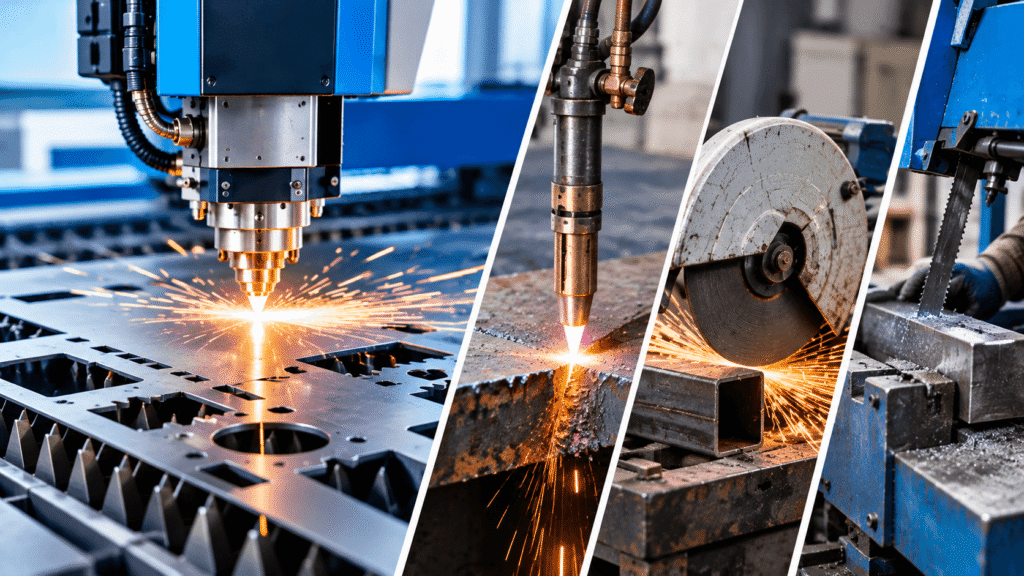
CNC Laser Cutting In Chennai vs Traditional Cutting Methods: Cost, Speed and Accuracy Compared
A fabricator I know in Ambattur once ordered 400 mild-steel brackets cut by shearing and finished by hand. The parts arrived late, the hole positions had drifted by almost a millimetre, and nearly a third went back for rework. He switched to laser the following month and never looked back. His story isn’t unusual, and it’s why CNC Laser Cutting In Chennai comes up in almost every sourcing conversation these days. But does it beat shearing, sawing and plasma every time? Not quite. Let’s break it down properly.
The Quick Comparison
| Factor | CNC Laser Cutting | Traditional Methods |
| Accuracy | ±0.05 to ±0.1 mm | ±0.5 to ±1 mm, operator-dependent |
| Speed (thin sheet) | Fast, runs unattended | Slower, needs repositioning |
| Tooling cost | None, just a CAD file | Dies, blades, fixtures |
| Edge finish | Clean, minimal burrs | Usually needs grinding |
| Material waste | Low, thanks to nesting | Higher |
| Thick plate (30 mm+) | Costly | Often cheaper (plasma, oxy-fuel) |
Cost: Look Past the Hourly Rate
Laser machines carry a higher hourly rate than a basic shearing setup, and that’s where most buyers stop reading. Don’t. The real bill includes tooling, labour, rework and wasted material.
Laser needs no dies or custom blades, so a design change costs you a new file rather than a new tool. One operator can load a sheet and let the machine run, while manual cutting ties up a person for the whole job. Nesting software packs parts tightly, which matters when steel and aluminium prices swing every quarter. Add the grinding and deburring that traditional cuts usually demand, and the “cheaper” option often isn’t.
Traditional methods still win in three situations: very thick plate, rough one-off cuts, and huge runs of a single simple shape, where a stamping die pays for itself.
Speed: Fast, With One Caveat
On thin and medium sheet, fibre lasers are hard to beat. They cut quickly, switch between jobs in minutes and don’t slow down at the end of a shift. Traditional methods lose hours to measuring, marking, tool changes and realignment.
The caveat is thickness. Once you go past roughly 25 to 30 mm, plasma or oxy-fuel can match or overtake laser on raw cutting speed, usually at a lower running cost.
Accuracy: Where Laser Earns Its Reputation
A tolerance of ±0.1 mm is routine on a good laser, and the 500th part looks like the first. That matters for enclosures, machine guards, brackets and electrical panels, where parts need to assemble without persuasion from a hammer.
Manual and semi-manual cutting leans on operator skill and concentration, and even great operators drift over a long shift. The narrow beam also keeps the heat-affected zone small, so thin sheets are less likely to warp.
Advantages and Disadvantages at a Glance
Laser cutting, the good: tight tolerances, clean edges, intricate shapes, less scrap, quick turnaround and easy repeat orders.
Laser cutting, the catch: higher machine investment, limits on very thick plate, and reflective metals like copper and brass need the right type of fibre laser.
Traditional cutting, the good: lower entry cost, solid performance on thick or rough work, and easy to find.
Traditional cutting, the catch: looser tolerances, extra finishing, more manual labour and very little design freedom.
Which One Should You Pick?
If you need precision, repeat batches or complicated profiles, go with laser. If you’re cutting heavy structural plate or doing a rough one-off, traditional methods make sense. Plenty of smart buyers mix both: plasma for the thick frame, laser for the precision parts that bolt onto it. For most sheet-metal work under 20 mm, CNC Laser Cutting In Chennai simply delivers more consistent results per rupee spent.
What’s Changing in 2026
Fibre lasers keep gaining power, which pushes the thickness ceiling a little higher every year. AI-assisted nesting is trimming scrap further. Buyers are also moving away from phone-tag quoting and comparing capacity, lead times and pricing online before they commit. And with sustainability pressure building, energy-efficient machines and low scrap rates are becoming part of the standard buying checklist.
Practical Tips Before You Order
- Confirm material and thickness first. Everything else follows from that.
- Send clean DXF or DWG files. Messy drawings lead to wrong quotes and delays.
- Ask about tolerance, not just price. A rock-bottom quote with loose tolerance costs more later.
- Request a sample piece before committing to a big batch.
- Think about the next step. If you’re cutting mould plates or fixtures, the Injection Molding Companies In Chennai you work with will expect flat, burr-free parts.
- Compare at least three suppliers. Indust makes that shortlist quicker by connecting buyers and suppliers in one place, so you spend less time chasing quotes.
Frequently Asked Questions
Is laser cutting always more expensive?
No. The hourly rate is higher, but savings on tooling, labour, rework and material often bring the total cost down, especially for small and mid-size runs.
Which metals can be laser cut?
Mild steel, stainless steel, aluminium, brass and copper are all common. Reflective metals need a suitable fibre laser.
Is laser cutting suitable for tooling and moulding work?
Yes. Base plates, shims and fixtures benefit from precise, clean-edged cuts, which is why many mould makers and Injection Molding Companies In Chennai outsource their flat parts to laser shops.
What should I send for an accurate quote?
Your CAD file, material, thickness, quantity and tolerance requirement. The more complete the brief, the more reliable the price.
The Bottom Line
Match the method to the job. For precision, repeatability and speed on sheet metal, laser is the stronger bet, while older methods still make sense for heavy plate and rough work. When you’re ready to compare suppliers without the runaround, Indust is a natural place to start for manufacturers, suppliers and procurement teams who want to source faster and smarter.