
Essential Export Documents for International Trade: A Complete Guide for Businesses
Introduction
Export documentation is a critical part of international trade because it helps businesses meet customs requirements, communicate shipment details, establish the terms of a sale, and demonstrate compliance with applicable regulations. Missing, inaccurate, or inconsistent documents can delay cargo clearance, increase storage costs, and create disputes between exporters, importers, and logistics providers.
The documents required for an export transaction depend on the product, destination country, transportation method, payment arrangement, and applicable trade agreements. A shipment of clothing, for example, may require a different set of compliance documents from agricultural produce, chemicals, or industrial machinery.
The scale of international trade makes efficient documentation particularly important. According to UN Trade and Development (UNCTAD), the global average implementation rate for trade facilitation measures reached 72% in 2025, up from 68.6% in 2023, reflecting continued progress in simplifying and digitizing cross-border trade procedures. Source: UNCTAD.
For exporters, understanding the purpose of each document helps reduce avoidable errors, prepare shipments more efficiently, and establish clearer communication with overseas buyers.
What Documents Are Required for International Exports?
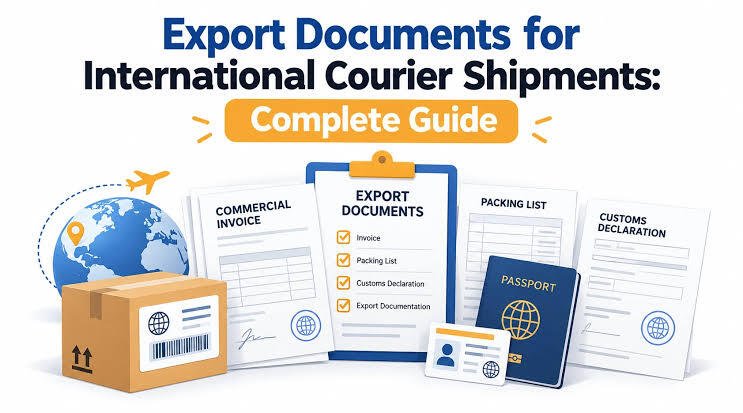
The documents required for an international export shipment depend on the nature of the goods and the rules of the importing country. However, many commercial transactions use a core set of documents, including a commercial invoice, packing list, transport document, and relevant customs declarations.
Additional paperwork may be required to demonstrate the origin of goods, satisfy product regulations, or qualify for preferential tariff treatment under a trade agreement.
Before dispatching a shipment, exporters should confirm the documentation requirements with the buyer, freight forwarder, customs broker, and relevant authorities. The U.S. International Trade Administration provides an overview of common export documents and explains that destination-country requirements can vary. Source: Trade.gov.
Common export documents include:
- Commercial invoice: Records the transaction, goods sold, and amount payable.
- Packing list: Describes the shipment’s contents, packaging, quantities, and weights.
- Bill of lading or air waybill: Provides transport-related information and serves functions determined by the transport document used.
- Certificate of origin: Identifies the country of origin when required or commercially necessary.
- Export customs declaration: Supplies information required by the exporting country’s customs authority.
- Pro forma invoice: Presents proposed transaction details before a final commercial invoice is issued.
- Product-specific certificates: Demonstrate compliance with applicable health, safety, quality, or technical requirements.
Not every shipment requires every document. Businesses should create a checklist tailored to each product and destination rather than assuming a single document package works for all export transactions.
What Is a Commercial Invoice, and Why Is It Important?
A commercial invoice records the sale of goods between the exporter and the overseas buyer. It provides information used by the buyer, customs authorities, and other parties involved in processing the transaction.
The invoice typically identifies the seller and buyer, describes the goods, specifies quantities and prices, and states the currency and relevant transaction details. Customs authorities may use the information to assess the value of imported goods and determine applicable duties.
For example, an exporter shipping 500 units of a product should ensure that the invoice quantity, unit price, total value, product description, and currency match the agreed commercial terms. Differences between the invoice and other shipping documents can lead to questions or additional checks.
A commercial invoice should generally include:
- Exporter and importer names and addresses.
- Invoice number and date.
- Clear product descriptions and quantities.
- Unit prices, total value, and transaction currency.
- Country of origin where required.
- Relevant shipping or delivery information.
- Applicable references, declarations, or other details required by the destination market.
The invoice should accurately reflect the actual transaction. Businesses should not understate values or use misleading descriptions to reduce customs duties, as this may result in penalties, shipment delays, or other legal consequences.
What Is a Packing List in Export Shipping?
A packing list describes how goods are packaged and organized within a shipment. It helps buyers, carriers, warehouse staff, and customs officials understand the shipment’s physical contents.
Unlike a commercial invoice, which focuses on the transaction and its financial value, a packing list provides more detailed information about packages, quantities, dimensions, and weights. It is particularly useful when a shipment contains multiple cartons, pallets, crates, or product variations.
For example, an exporter shipping 200 cartons of household goods should identify the number of cartons and provide accurate package weights and dimensions where required. This information can support cargo handling, warehouse planning, and customs inspection.
A packing list commonly includes:
- Exporter and buyer details.
- Invoice or shipment reference.
- Description of goods and quantities.
- Number and type of packages.
- Net and gross weights.
- Package dimensions and identifying marks.
- Relevant shipping details.
The packing list and commercial invoice should be consistent wherever their information overlaps. A mismatch between declared quantities and the actual shipment can create unnecessary complications during inspection or delivery.
What Are a Bill of Lading and an Air Waybill?
A bill of lading and an air waybill are transport documents used for different shipping methods. The appropriate document depends primarily on how the goods are transported and the arrangements between the parties.
A bill of lading is commonly associated with sea freight. Depending on its type and the applicable legal framework, it may serve as a receipt for goods, evidence of the contract of carriage, and a document of title.
An air waybill is used for air cargo. It records important shipment and carriage details but generally does not function as a negotiable document of title in the same way as certain bills of lading.
Exporters should confirm that the transport document reflects the correct shipper, consignee, cargo description, destination, and shipment details.
Important checks include:
- Verify the names and addresses of the relevant parties.
- Confirm that package counts and cargo descriptions are accurate.
- Check the destination and routing information.
- Review the document type required by the buyer or bank.
- Ensure the transport details are consistent with other transaction documents.
Document requirements may differ when payment is made through a documentary letter of credit. In those transactions, even small discrepancies can create payment complications, so documents should be reviewed against the exact contractual and banking requirements.
Why Are Certificates of Origin and Product Certificates Important?
Certificates of origin and product-specific certificates help establish facts about goods that may be relevant to customs clearance, tariff treatment, or regulatory compliance.
A certificate of origin identifies the origin of goods according to the applicable origin rules. Importers may need it to satisfy customs requirements or claim preferential tariff treatment under an eligible trade agreement. The required format and issuing authority depend on the destination and the circumstances of the shipment.
Product certificates serve different purposes. Agricultural products may require phytosanitary or health documentation, while certain manufactured products may need evidence of conformity with safety or technical standards.
Exporters should verify the requirements for each product-market combination before accepting an order. A document that is acceptable in one country may not satisfy another country’s regulations.
A practical compliance checklist includes:
- Confirming the applicable product classification and import rules.
- Checking whether a certificate of origin is required.
- Identifying relevant health, safety, or technical certificates.
- Verifying whether documents must be issued by an authorized body.
- Confirming whether originals, electronic copies, translations, or legalization are required.
- Checking document validity dates and shipment-specific details.
B2B Trade Services should obtain certificates from the appropriate authorities or authorized organizations and avoid assuming that a general quality certificate satisfies every regulatory requirement.
How Can Exporters Avoid Documentation Errors?
Exporters can reduce documentation errors by standardizing their preparation process and checking information before the shipment is released. The most common problems include inconsistent quantities, incorrect product descriptions, missing signatures, inaccurate consignee details, and expired or unsuitable certificates.
Documentation errors can affect more than customs clearance. They may also delay delivery, complicate insurance claims, or prevent payment when a transaction requires strict documentary compliance.
Businesses can establish a simple review process:
- Confirm the buyer’s documentation requirements before production or dispatch.
- Prepare documents using the final agreed commercial information.
- Check quantities, product descriptions, values, and party details across documents.
- Verify that required certificates are valid and issued by the appropriate authority.
- Review transport instructions and destination details with the freight forwarder.
- Retain copies of final documents and relevant correspondence.
- Correct discrepancies before shipment whenever possible.
For example, if a purchase order specifies one product grade but the invoice uses a different description, the exporter should resolve the inconsistency before the documents are submitted. Accurate records make it easier to explain the shipment and respond to questions from customs authorities or buyers.
Can Digital Documentation Make International Trade More Efficient?
Digital documentation can improve the speed and consistency of trade processes by reducing manual data entry, making records easier to retrieve, and supporting electronic submission where authorities and trading partners accept it.
UNCTAD’s 2025 global survey found that the average implementation rate for trade facilitation measures increased to 72% across the surveyed economies, with cross-border paperless trade showing particularly strong progress. However, digital readiness and legal acceptance still vary between countries. Source: UNCTAD.
Businesses can improve their documentation workflow by:
- Maintaining standardized digital templates.
- Using consistent product descriptions and company details.
- Storing documents securely with clear file names and version control.
- Sharing files through appropriate, access-controlled channels.
- Confirming whether the destination authority accepts electronic documents.
- Keeping backups and records of submitted versions.
Digital files do not automatically replace original documents when physical originals or specific formats are legally required. Exporters should confirm the applicable rules before relying entirely on electronic records.
Frequently Asked Questions
What is the most important document in international export?
There is no single document that is most important for every shipment. The commercial invoice is central to many transactions, but customs declarations, transport documents, certificates, and other records may be equally essential depending on the goods and destination.
Is a certificate of origin required for every export?
No. Requirements depend on the importing country, product, trade agreement, and buyer’s needs. Exporters should confirm whether a certificate is mandatory or useful for the specific transaction.
Who prepares export documents?
The exporter often prepares commercial documents, while freight forwarders, customs brokers, carriers, chambers of commerce, or government authorities may prepare, issue, or process particular documents. Responsibilities should be agreed before shipment.
How can businesses check export documentation requirements?
Businesses can consult the importing country’s customs authority, official government trade portals, the buyer, and qualified customs or freight professionals. Product-specific regulations should be checked separately.
Conclusion
Accurate export documentation helps businesses meet regulatory requirements, coordinate shipments, and maintain clear commercial records. Although the exact documents vary by product and destination, exporters should understand the purpose of invoices, packing lists, transport documents, origin certificates, and any required product-specific paperwork.
A standardized review process, early confirmation of destination requirements, and appropriate use of digital tools can reduce preventable errors. By treating documentation as an essential part of export planning rather than a last-minute administrative task, businesses can manage international transactions more reliably and prepare for sustainable participation in global trade.