
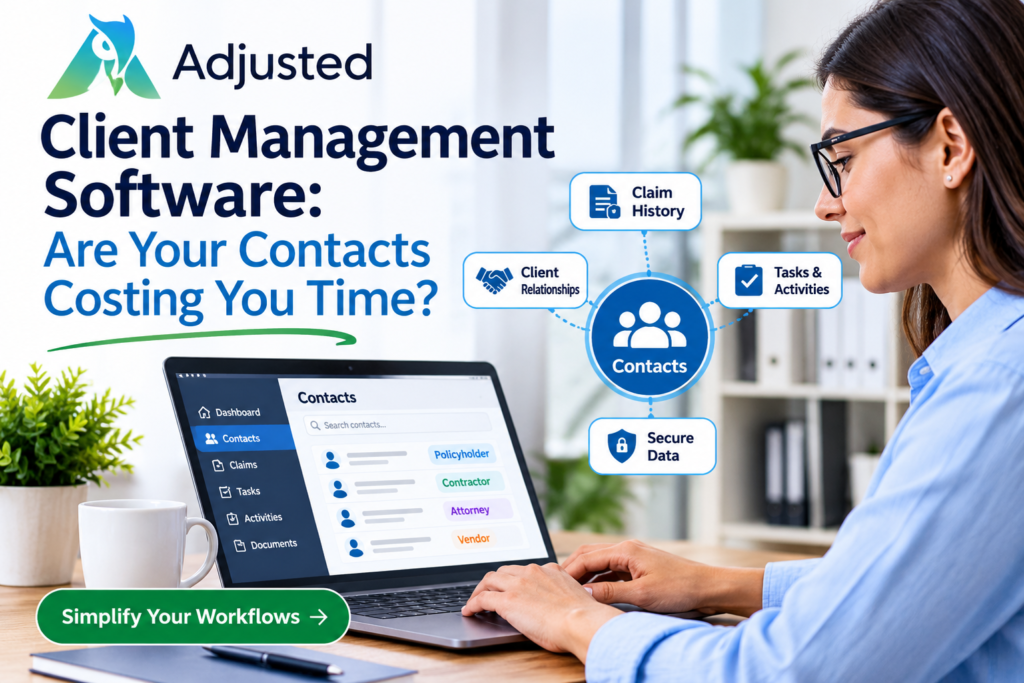
Client Management Software: Are Your Contacts Costing You Time?
Client management software helps insurance professionals organize contacts, track claim histories, manage tasks, and maintain better client relationships. Instead of searching emails, spreadsheets, and disconnected files, teams can access important contact information from one central location.
For insurance professionals, managing contacts is more than saving names and phone numbers. Each contact may be connected to multiple claims, activities, documents, and team members. Keeping these relationships organized helps reduce confusion and saves valuable time.
The right software makes daily work easier. It helps your team find information quickly, understand previous interactions, and manage claims with fewer unnecessary steps.
Why Do Insurance Professionals Need Client Management Software?
Insurance professionals work with many people throughout the claim process. These contacts may include policyholders, property owners, attorneys, contractors, adjusters, vendors, and internal team members.
Managing these relationships manually becomes difficult as claim volume increases. A contact’s phone number might be stored in one spreadsheet. Their previous claim details could be inside another file. Important communication may remain buried in someone’s inbox.
This creates unnecessary delays. Team members may repeat questions, miss important updates, or contact the wrong person. These problems affect productivity and make collaboration harder.
Client management software creates a central location for contact information. Your team can access important details without searching multiple systems. It also helps maintain consistent records when responsibilities change.
For insurance agencies and claims businesses, organized contact information supports smoother workflows. It allows professionals to spend less time searching for details and more time handling their actual responsibilities.
How Does Client Management Software Improve Contact Management?
Effective Contact Management helps insurance professionals understand who they work with and how each relationship connects to their business.
A basic contact management system stores names, phone numbers, email addresses, and company details. However, insurance professionals need more context. They need to know why someone is involved in a claim and what happened during previous interactions.
Good insurance contact management software connects people with relevant claims, tasks, and activities. This gives team members a clearer picture of each relationship.
For example, when an adjuster opens a contractor’s contact record, they should be able to identify related claims and previous activities. They can review existing information before making another call.
This reduces repeated communication and improves team coordination. It also helps employees understand their responsibilities when working with multiple contacts.
An organized contact directory makes information easier to find. It supports better communication, reduces duplicate records, and helps teams maintain accurate information throughout their workflows.
What Features Should Insurance CRM Software Include?
Choosing insurance CRM software requires more than checking whether it stores contact information. Insurance professionals need features that support their actual workflows.
A useful system should provide:
- Centralized contact directory: Store internal team members and external contacts in one organized location.
- Claim history: Review every claim associated with a particular contact.
- Claim relationships: Connect contacts with claims, tasks, and activities.
- Searchable records: Find people quickly using relevant contact information.
- Secure information handling: Protect sensitive personal information through appropriate security measures.
- Updated records: Reduce manual work by keeping contact information current.
- Advanced contact workflows: Support businesses handling large contact volumes and complex relationships.
These features help insurance professionals maintain organized records while improving collaboration.
However, businesses should check which features are currently available. Some software providers offer advanced features through additional packages or future releases.
How Is Insurance Agency CRM Software Different From Generic CRM Tools?
Generic CRM systems usually focus on sales pipelines, marketing campaigns, customer conversations, and business opportunities.
Insurance professionals have different requirements. Their work involves claims, property information, documentation, multiple parties, and ongoing activities. A contact may appear across several claims, making relationship tracking especially important.
Insurance agency CRM software should support these industry-specific relationships. It should help teams connect contacts with relevant claims instead of treating every person as an isolated customer record.
For example, a public adjuster may work with the same contractor across several property damage claims. A claims team may communicate with different representatives from one insurance company.
Without connected records, employees must remember these relationships or search manually. Insurance client management software makes this information easier to access.
The right solution should fit your daily processes. It should help your team organize information without creating additional administrative work.
How Does Adjusted Make Client Management Easier?
Adjusted provides claims management software designed for property claims professionals. Its platform combines claim information, documents, estimates, policy details, and related workflows.
Their insurance client management software focuses on relationships within the claims process rather than traditional sales pipelines.
The contact management system provides a central directory for internal team members and external contacts. Users can connect contacts with claims, tasks, and activities.
This makes it easier to understand a contact’s involvement in different claims. Instead of searching separate records, professionals can access related information through connected workflows.
Adjusted also supports claim-focused work beyond contact storage. Its platform helps organize claim files, documents, estimates, and activities in one workspace.
This approach makes their software particularly relevant to public adjusters, restoration contractors, and property claims professionals who manage many relationships throughout the claim lifecycle.
How Can Lead Management Software Support Insurance Workflows?
Lead management software helps businesses organize prospective clients from their first inquiry through follow-up and conversion.
Insurance agencies often receive inquiries through phone calls, websites, referrals, and other channels. Without an organized system, these inquiries can become difficult to track.
A lead management system helps teams record prospect information, assign responsibilities, and track communication. This gives employees better visibility into which leads require attention.
However, lead management and claims contact management serve different purposes. Lead management focuses on potential business opportunities. Claims contact management focuses on people connected to existing claims and activities.
Insurance professionals should choose software based on their primary needs. If their daily work involves property claims, connected claim records may offer more value than traditional sales pipelines.
Organized contacts also help teams maintain continuity. When someone takes over a lead or claim, they can review existing information instead of starting from scratch.
What Should You Consider Before Choosing Contact Management Software?
Before investing in contact management software, consider how your team currently handles information.
First, identify where contact records are stored. If your employees use multiple spreadsheets, email accounts, and shared folders, centralization should be a priority.
Next, consider how contacts relate to your daily work. Insurance professionals may need connections between contacts, claims, tasks, and activities. A system that only stores names and phone numbers may not solve their biggest problems.
Data security is another important consideration. Contact records may contain sensitive personal information. Review available security features and understand how the software handles protected data.
Finally, evaluate pricing and onboarding requirements. Look for transparent costs, practical support, and flexible terms.
Adjusted offers no setup fees, no contract, and a 30-day money-back guarantee. These terms allow businesses to evaluate the platform without committing to a long-term agreement.
Make Contact Management Easier for Your Claims Team
Managing insurance contacts shouldn’t require searching through countless spreadsheets, emails, and disconnected records. The right client management software helps your team organize relationships, access claim histories, and manage daily activities more efficiently.
Adjusted provides a claims-focused workspace that connects contacts with the information your team needs. If you want to simplify your workflows and improve contact organization, schedule a demo to see how their platform works for your business.
Frequently Asked Questions
1. What is client management software?
It organizes client information, communication history, activities, and relationships in one accessible workspace.
2. How does insurance CRM software help claims professionals?
It connects contacts with claims, tasks, and activities, helping teams manage relationships and information efficiently.
3. What is Contact Management?
Contact Management stores, organizes, and tracks information about people and their business relationships.
4. Is insurance contact management software useful for small teams?
Yes, it helps small teams organize contacts, share information, and reduce repetitive administrative work.
5. What is the difference between CRM and lead management software?
CRM manages relationships, while lead management focuses on prospects and their progress toward becoming clients.
6. Does Adjusted offer a money-back guarantee?
Yes, Adjusted offers a 30-day money-back guarantee, with no setup fees and no contract.
7. Can contacts be connected to multiple claims?
Yes, Adjusted allows contacts to be linked with claims, tasks, and activities for better organization.