
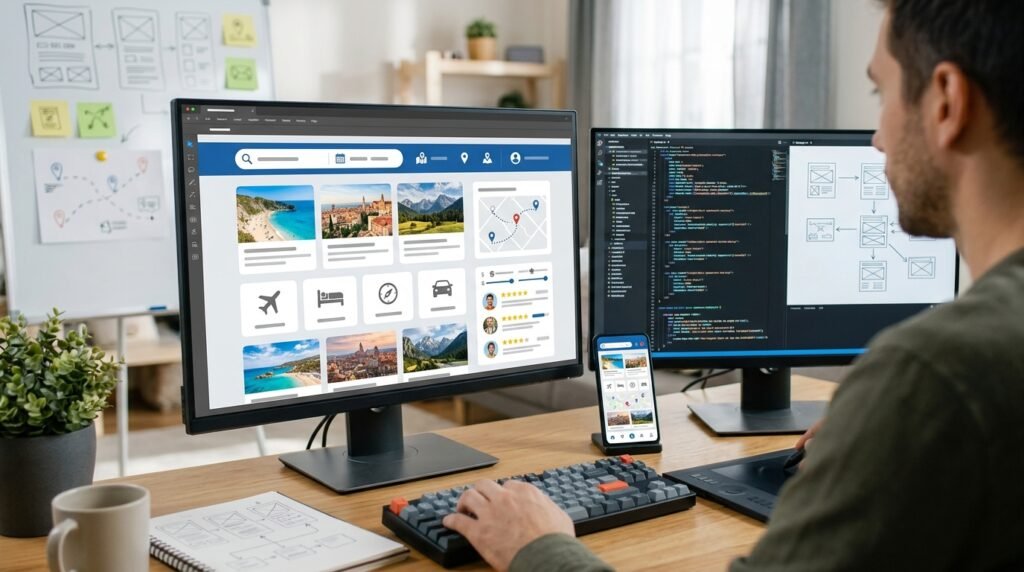
Travel Website Development: Features and Functions to Consider
Whilst someone may enjoy a particular place to visit, sometimes poor price visibility, out-of-date imagery and/or poor access to key information will cause them to avoid a site. A good travel & tourism website development will address these issues and provide an efficient digital service. It will enable people to research, analyse and decide upon products and services.
Navigation
Good travel & tourism website design and development involves dividing content into suitable sections. This could include:
- Places to visit and holidays
- Airline tickets, hotels and transport
- Experiences, tours and activities
- Information and FAQs
- Company and customer service information
Navigation needs to allow easy access to key pages. People also benefit from a search tool for rapidly identifying places of interest.
Destination Information
An appropriate Tourism Website Development will include detailed information relating to individual places. Information requirements will differ between, for example, families and backpackers. Content should centre on traveller queries and incorporate original images, local tips and maps as well as sample routes.
Booking
A good website for people to book travel should provide an uncomplicated booking process. Facilities may include:
- Ability to choose and check dates
- Option to select people, rooms or guests
- Easy-to-view pricing, plus associated and leviable costs
- Secure payment methods
- Confirmation and reference numbers
Include information regarding cancellation terms, deposits, refunds and what is included within holidays. Continually assess the booking process including successful and unsuccessful payment attempts and date availability.
Mobile Optimisation
Appropriate travel & tourism website development will adapt a site to suit varying screen sizes. Buttons should be easily clickable and text should be legible. Furthermore, key items should not be obscured by superfluous material. Assess a website’s performance on less rapid internet connections.
Search and Refinement
Ideally, a developed travel website will allow people to refine their searches by selecting:
- Places and origin
- Dates and holiday length
- Price bracket and hotel standard
- Party size
- Experiences, amenities and holiday style
Refinements should themselves be easily alterable and output should be precise. Where no options match a search, offer people alternative refinement criteria.
Customer Feedback and Company Credibility
Present authentic customer feedback alongside company contact information. Clearly state what people can expect from your offering. Particular feedback is especially important for a tour company as it can relate to aspects such as hotel standard, tutor expertise, on-time performance and customer service. Steer clear of fabricated feedback and do not misrepresent examples as authentic feedback.
Information and Travel Advice
Include travel advice such as packing lists, transport information, seasonal hints and visa and emergency contact details. Provide date amendment information and advise people where to view authoritative information relating to entry requirements.
Payment and Security
Consider these security and payment related aspects within Tourism Website Development:
- Install and regularly renew an SSL certificate.
- Embed trustworthy payment processing tools.
- Provide secure sign-in functionality for customer accounts.
- Only record essential booking-related information.
- Clearly outline company data protection and storage procedures.
- Continually update website programmes, add-ons and back-ups.
Wherever possible, allow payment processors to manage card details. Review pertinent data protection and payment regulations.
SEO, CMS and Analysis
Develop highly relevant and well-structured pages for places and services. Include appropriate titles, subheadings and photo ‘alt’ text. Avoid producing duplicate, low-value pages. With the aid of a content management system, non-technical personnel can edit holiday packages, pricing, information and images. Analysis tools highlight popular pages together with areas where bookings are not being made. Investigate why people may be abandoning a booking process. This could involve excessive or unclear fees, complicated booking forms and/or payment issues. Also assess lack of confidence inspiring information. Develop improvements in line with observed behaviour.
Links and Customer Service
A Travel Agency website may link to:
- A booking system and stock management programme.
- Customer Relationship Management (CRM) tools to handle customer queries.
- Email tools for sending booking and reminder information.
- Instant chat or correspondence facilities.
- Mapping and other travel related sites.
Although chatbots can respond to common queries regarding holidays and company policy, people should still easily access human customer service.
Ensuring Compatibility Between Website Features
Features are most effective if they complement each other and fully address the customer experience. For instance, if a tour firm frequently gets asked about dates, hotels, prices and cancellations, appropriate features such as in-depth holiday information, date availability, clear pricing and an enquiry form can decrease such queries and enhance the booking process. Before a website goes live, invite new users to search for, analyse and attempt to book a holiday. This will enable you to identify and address any issues.
Businesses should determine which features are most suitable. Whereas a local guide may just require an enquiry form and tour information, a bigger travel agency will likely need live stock information, multi-currency functionality and links to suppliers. Decisions on features should be influenced by customer requirements, together with financial and maintenance factors. As customer expectations evolve, travel & tourism website development should continue to be relevant and beneficial.
Conclusion: Developing an Easy-to-use Website
In addition to showcasing places, the ideal website alleviates doubts and instils confidence. However, rather than simply adopting current trends, travel & tourism website development should be driven by customer requirements. Initially establish good navigation, precise information, secure booking, mobile optimisation and customer service. Then introduce further features only if and when they effectively address particular issues. Often, a simpler, well-functioning website will better meet customer requirements than a complex one which includes numerous, but hard-to-use, features.
Pilot a booking procedure from the perspective of a first time site user. Evaluate aspects such as pricing, company policy and customer service. Amend areas that cause hesitancy. Structured processes encourage stronger booking decisions. Again, rather than emphasising the quantity of features, it is crucial that a site efficiently addresses all key decision points. Essentially, when a website both honestly addresses customer queries and enables seamless booking, it provides a valuable service.
Why Choose The Custom Websites for Travel Website Development?
The Custom Websites specialises in developing innovative and easy to use web sites for travel agencies, tour companies and tourism related sectors. We place great importance upon producing highly tailored web sites which are easy to navigate, visually appealing and include effective booking facilities. Whatever your requirements are for a new or enhanced website, we support you to ensure that your website is working effectively in support of your business aims. Find out further information regarding knowledge and service provision via The Custom Websites’ Clutch profile