
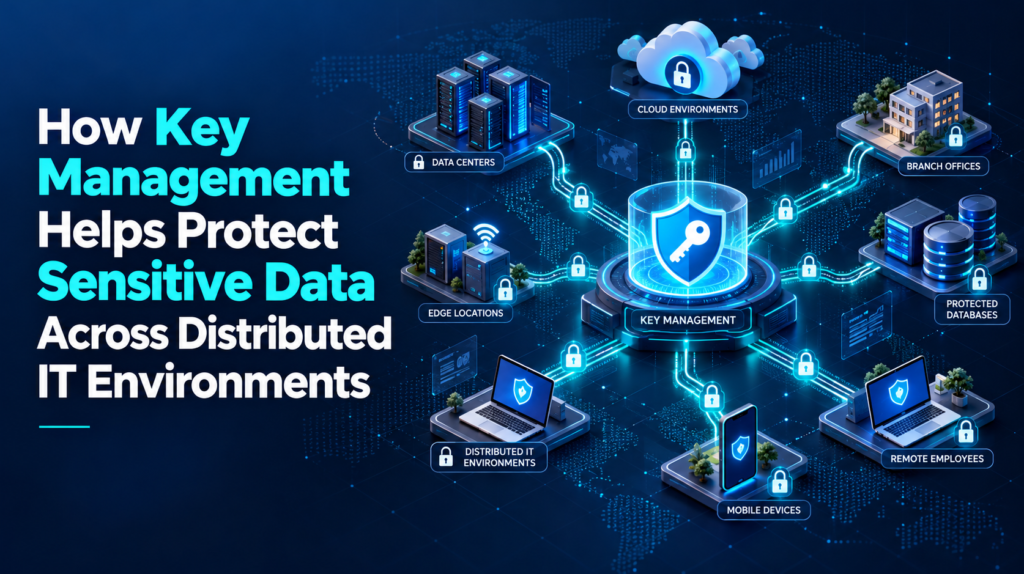
How Key Management Helps Protect Sensitive Data Across Distributed IT Environments
Introduction
Modern organizations rarely operate from a single IT environment.
Businesses may use public cloud platforms, private cloud infrastructure, on-premises data centers, SaaS applications, enterprise databases, remote systems, and APIs.
These environments support important business operations, but they also create additional data protection requirements.
Sensitive information can move between different systems throughout its lifecycle.
Organizations therefore need security controls that protect information regardless of where it resides.
Encryption provides an important layer of protection. However, encryption depends on cryptographic keys.
Businesses must protect these keys and manage them throughout their lifecycle.
This makes Key management an important part of distributed data security.
Key management in cryptography provides the framework organizations need to manage encryption keys across complex environments.
What Is a Distributed IT Environment?
A distributed IT environment consists of systems and workloads operating across different infrastructure locations and platforms.
An enterprise may combine:
- Public cloud
- Private cloud
- On-premises infrastructure
- SaaS platforms
- Remote applications
- Mobile services
- Databases
- APIs
Data may move between these systems.
This distribution creates challenges for security teams.
Why Sensitive Data Needs Protection
Businesses process many categories of sensitive information.
These may include:
- Customer records
- Financial information
- Employee data
- Intellectual property
- Transaction information
- Business documents
- Application data
Unauthorized access to this information can create operational, financial, and reputational risks.
Organizations therefore use multiple security controls.
Encryption and Key Management
Encryption converts readable information into an encrypted format.
The cryptographic key controls access to the encrypted information.
This creates an important relationship:
Sensitive data → Encryption → Cryptographic key → Key management
Organizations must protect both the encrypted information and the key.
If attackers gain access to a key, they may potentially weaken the protection provided by encryption.
Key Management in Cryptography
Key management in cryptography covers the lifecycle of cryptographic keys.
This includes:
- Generation
- Storage
- Distribution
- Access
- Usage
- Rotation
- Backup
- Recovery
- Retirement
- Destruction
Organizations should define controls for each stage.
Managing Keys Across Cloud and On-Premises Systems
Hybrid environments can create complex cryptographic requirements.
For example, an enterprise may host its database on-premises while operating its customer-facing application in the cloud.
The application may need access to encrypted information stored within the database.
Security teams must therefore manage cryptographic keys across both environments.
Centralized Key management can help organizations establish consistent policies.
Key Inventory
Organizations should maintain an accurate inventory of cryptographic keys.
The inventory should include:
- Key owner
- Key purpose
- Associated system
- Protected data
- Lifecycle status
- Rotation schedule
This provides security teams with greater visibility.
Access Control
Organizations should restrict access to cryptographic keys.
The principle of least privilege should apply to both users and applications.
An application should receive only the permissions required for its approved functions.
This reduces unnecessary exposure.
Key Separation
Organizations should consider separating keys based on:
- Application
- Environment
- Data sensitivity
- Business function
Using separate keys can help limit the potential impact of a compromise.
Key Rotation
Organizations should establish key rotation policies.
Rotation replaces an existing key with a new one.
Businesses should consider application dependencies before rotation.
Automated rotation can reduce manual effort, but organizations should test automated workflows carefully.
Key Backup and Recovery
Key recovery represents an important part of data protection.
If an organization loses a critical encryption key, authorized users may lose access to protected information.
Businesses should maintain secure backups and test recovery procedures regularly.
Key Management for Cloud Applications
Cloud applications may use encryption for:
- Databases
- Cloud storage
- Backups
- Application data
- Communications
Each encryption mechanism may involve cryptographic keys.
Organizations should manage these keys through consistent policies.
Key Management for Enterprise Applications
Applications may also use cryptographic keys for:
- API authentication
- Digital signatures
- Secure communications
- Data encryption
Developers should not store sensitive keys directly in application source code.
Instead, applications should use controlled cryptographic services.
Monitoring Key Usage
Distributed environments require strong monitoring.
Security teams should monitor:
- Key access
- Key creation
- Key rotation
- Failed access attempts
- Administrative changes
- Key retirement
Monitoring can provide visibility into unusual activity.
Handling Compromised Keys
Organizations should prepare for potential key compromise.
A response process may include:
- Identifying the affected key
- Determining which systems use it
- Restricting access
- Generating a replacement
- Updating dependent systems
- Retiring the affected key
- Investigating potential impact
This process should integrate with the organization’s incident response strategy.
Challenges in Distributed Key Management
Multiple Infrastructure Platforms
Different environments may use different encryption mechanisms.
Key Sprawl
Organizations may accumulate large numbers of keys.
Limited Visibility
Security teams may not know where every key resides.
Inconsistent Policies
Different teams may apply different security practices.
Legacy Systems
Older systems may create integration challenges.
Best Practices
Businesses should:
- Maintain a centralized key inventory
- Assign clear ownership
- Apply least privilege
- Separate keys where appropriate
- Establish rotation policies
- Automate suitable lifecycle operations
- Monitor key activity
- Protect backups
- Test recovery
- Retire obsolete keys
Conclusion
Distributed IT environments have made enterprise data protection more complex.
Organizations need to protect sensitive information across cloud platforms, databases, applications, SaaS services, and on-premises systems.
Encryption provides an important layer of protection, but cryptographic keys require their own security controls.
Key management in cryptography provides the framework for managing keys throughout their lifecycle.
Effective Key management can improve visibility, access control, rotation, recovery, and retirement across distributed environments.
By establishing consistent key management practices across cloud and on-premises infrastructure, organizations can strengthen data protection while maintaining better control over their cryptographic security.