
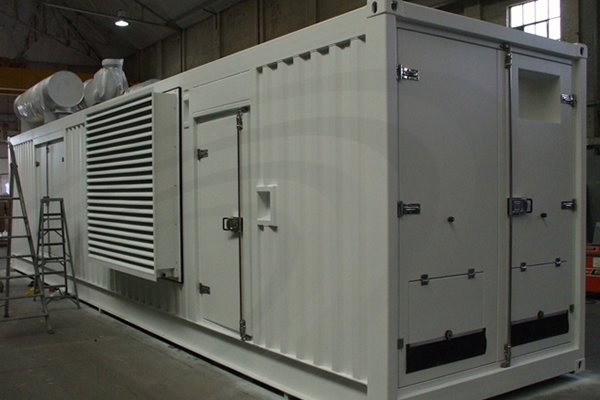
What Are Acoustic Containers? Complete Guide
Acoustic containers are engineered enclosures that absorb, block and contain sound, either to isolate a noise source or to protect a product or measurement from outside noise. They are used for noise testing, quiet-room measurements, and noise control in labs and production. Their design and verification are guided by standards such as ISO 3744/3745, ISO 10140 and ASTM E90.
What Does the Term Mean?
“Acoustic” comes from the Greek akoustikos, meaning “relating to hearing,” while “container” comes from the Latin continere, “to hold together.” Put together, the term describes a structure that holds sound in or keeps it out.
An acoustic container is a purpose-built enclosure that controls how sound enters, leaves and behaves inside a defined space, using insulation, absorption and damping.
A Simple Analogy
Imagine shouting in a large, empty room with bare walls. The echo that comes back is sound reflecting off hard surfaces. Now imagine the same room with thick curtains and carpet. The echo disappears because those soft materials absorb the energy.
An acoustic container applies both ideas at once. Dense outer walls stop sound from passing through (insulation), and porous inner linings stop it from bouncing around (absorption). Neither alone gives a quiet, controlled space.
Where Acoustic Containers Are Used
Automotive, aerospace, medical devices, telecom, consumer electronics, industrial machinery and power generation all rely on acoustic enclosures. Automotive teams test component noise such as pumps, fans and HVAC parts. Aerospace programs check equipment against vibration and acoustic environments. Medical manufacturers verify that devices stay quiet in clinical settings. Telecom and electronics companies measure product noise for labeling and compliance.
Each sector works to different standards, which changes the build. A medical device lab may need a very low internal noise floor. An aerospace test may need a structure that tolerates high sound pressure. A factory may need a modular, heavy-duty design that can be moved.
Types and Common Uses
The main variations are sound proof containers for machinery and generators, acoustic sound boxes for benchtop product testing, walk-in acoustic chambers, hemi-anechoic and anechoic test rooms, sound insulated boxes for small components, and modular enclosures for production lines.
A sound insulated box suits a single component test, while a walk-in chamber suits full-product measurement. Many teams start by searching for “acoustic containers” without knowing which category fits their application, which is a perfectly normal place to begin.
A common misconception is that egg cartons soundproofing works. Egg cartons scatter a little high-frequency sound but give almost no insulation, and they are not a valid substitute for engineered materials in any test environment.
Standards and Technical Specifications
Note that CISPR and similar EMC standards cover radio-frequency emissions, not acoustics. For acoustic work, the relevant references are different:
- ISO 3744 / ISO 3745: determination of sound power levels (engineering and precision grades; ISO 3745 requires anechoic or hemi-anechoic rooms).
- ISO 10140 and ASTM E90: laboratory measurement of airborne sound insulation (transmission loss).
- ISO 354 and ASTM C423: sound absorption measurement.
- MIL-STD-810 (Method 515) and RTCA DO-160: acoustic and vibration environments for defense and aerospace equipment.
- IEC 61672: specifications for the sound level meters used to verify performance.
Typical performance values depend on the design. Sound insulation of roughly 20–40 dB is common for general enclosures, and well-built chambers can exceed that. Usable frequency ranges often span about 100 Hz to 10 kHz, with low-frequency performance requiring much thicker linings. Internal background noise for measurement chambers is often targeted below 25–30 dBA.
HOW ACOUSTIC CONTAINERS ACHIEVE NOISE REDUCTION
Performance comes from combining three mechanisms. Mass and sealed construction (steel or composite panels with tight gaskets) block airborne sound. Porous absorbers such as mineral wool or acoustic foam, often 50–100 mm thick, dissipate mid- and high-frequency energy. Damping layers reduce panel vibration, which would otherwise re-radiate sound.
Doors, cable entries and ventilation openings are the weak points. A single unsealed gap can cut overall performance by several decibels, regardless of how good the walls are.
Practical tip: Plan cable pass-throughs and airflow before you buy. Use baffled or lined silencer vents and sealed feed-throughs, and request transmission loss data for the complete assembly, not just the panel.
Choosing the Right Solution
Are you in the process of choosing or installing sound proof containers, acoustic containers, an acoustic sound box, or a sound insulated box for your lab or plant? Don’t hesitate to contact us. Our account managers and acoustic experts can help even if you are not yet sure what you need. We can review your test standard, noise levels and space constraints, then suggest a configuration that fits.