
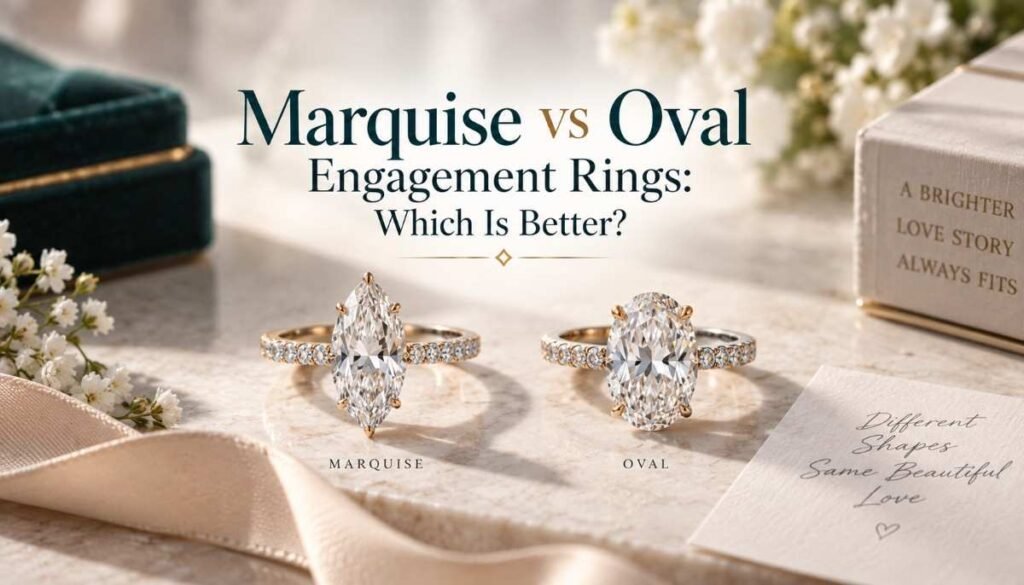
Marquise vs Oval Engagement Rings: Which Is Better?
Marquise vs oval is one of those engagement ring debates that comes down to more than personal taste. Both shapes share a similar advantage — they look larger than their actual carat weight — but they achieve that effect in different ways, and they suit different hands, styles, and lifestyles. Here’s a clear, honest comparison to help settle the marquise vs oval question for your own situation.
Why These Two Shapes Get Compared So Often
Marquise and oval diamonds are both elongated fancy shapes, which sets them apart from rounder cuts like cushion or round brilliant. That shared elongation is exactly why buyers weighing marquise vs oval often struggle to choose between them — both shapes create a similar slimming, elongating effect on the finger, just with a different overall silhouette.
What Is a Marquise Diamond?
A marquise cut features two-pointed ends and a long, narrow, boat-shaped profile. It’s one of the most elongated diamond shapes available, which makes it especially effective at maximizing perceived size relative to carat weight.
Key characteristics:
- The most elongated of all common diamond shapes
- Pointed tips that require careful mounting protection
- A distinctive, dramatic silhouette that stands out from more common shapes
What Is an Oval Diamond?
An oval cut is essentially a rounded, elongated version of a round brilliant diamond. It keeps much of round’s classic brilliance while adding the length and slimming effect associated with fancy shapes.
Key characteristics:
- A softer, more rounded silhouette than marquise
- Strong brilliance, closely related to round brilliant cutting patterns
- A versatile shape that suits a wide range of styles and hand types
Marquise vs Oval: Key Differences
Perceived Size
Both shapes look larger than their carat weight suggests, but marquise typically takes this further due to its more extreme elongation. For buyers prioritizing maximum perceived size within a budget, marquise often has a slight edge.
Brilliance and Sparkle
Oval diamonds generally offer more consistent brilliance, since their cutting pattern closely follows round brilliant principles. Marquise diamonds can be stunning as well, but their pointed ends sometimes create a subtle “bowtie” effect — a shadow visible across the center of the stone — which varies depending on the specific cut quality.
Durability and Everyday Wear
This is where the two shapes diverge most. Oval diamonds have no pointed corners, making them naturally more resistant to chipping during daily wear. Marquise diamonds have two vulnerable points that require proper V-prong protection to stay secure and undamaged over time.
Finger Flattering Effect
Both shapes elongate the finger, but marquise tends to create a more dramatic slimming effect due to its sharper, more extreme silhouette. Oval offers a similar benefit to a softer, more universally flattering profile.
Style and Personality
- Marquise suits buyers who want a bold, distinctive look that stands out from more common shapes
- Oval suits buyers who want elongation and brilliance without straying too far from a classic, timeless silhouette
Which Should You Choose?
A few questions can help clarify the marquise vs oval decision:
- Do you want a bold, statement shape or a softer, more versatile one? Choose marquise for the former, oval for the latter.
- How important is low-maintenance durability? Oval’s rounded edges are inherently more chip-resistant than marquise’s pointed tips.
- Do you want maximum perceived size, even at the cost of a more dramatic silhouette? Marquise generally offers a slightly stronger size illusion.
- What matches your hand shape and personal style? Both shapes flatter most hands, but marquise’s boldness suits those who want their ring to stand out immediately.
Buyers who want to compare both shapes directly can browse a marquise diamond ring alongside oval options to see how each one actually looks in person before deciding, since photos rarely capture the full difference between the two silhouettes.
Mounting Considerations for Both Shapes
Shape choice also affects mounting decisions. Marquise diamonds require V-prong settings to protect their pointed tips, making mounting choice less flexible than it is for oval stones. Oval diamonds, without vulnerable corners, offer more mounting flexibility, from classic prong settings to bezels and East-West orientations, without the same structural requirements of marquise demands.
FAQs: Marquise vs Oval Engagement Rings
1. Which diamond shape looks bigger, marquise or oval?
Ans. Marquise diamonds typically appear larger than the same carat weight in an oval cut, due to their more extreme elongation, though both shapes look larger than round diamonds of equal weight.
2.Is a marquise or oval diamond more durable for everyday wear?
Ans. Oval diamonds are generally more durable for daily wear, since they lack the pointed tips that make marquise diamonds more vulnerable to chipping without proper V-prong protection.
3. Does marquise or oval flatter the hand more?
Ans. Both shapes create an elongating, flattering effect on the finger. Marquise tends to create a more dramatic slimming effect, while oval offers a softer, more universally flattering silhouette.
The Bottom Line
Marquise vs oval ultimately comes down to how bold or classic you want your ring to feel, along with how much you prioritize durability versus dramatic visual impact. Oval offers brilliance and everyday practicality in a softer silhouette, while marquise delivers a boulder, a more distinctive look for buyers willing to prioritize proper mounting care. Whichever direction feels right; both shapes hold their own once you’re ready to Buy engagement ring online and compare real pieces rather than photos alone.