
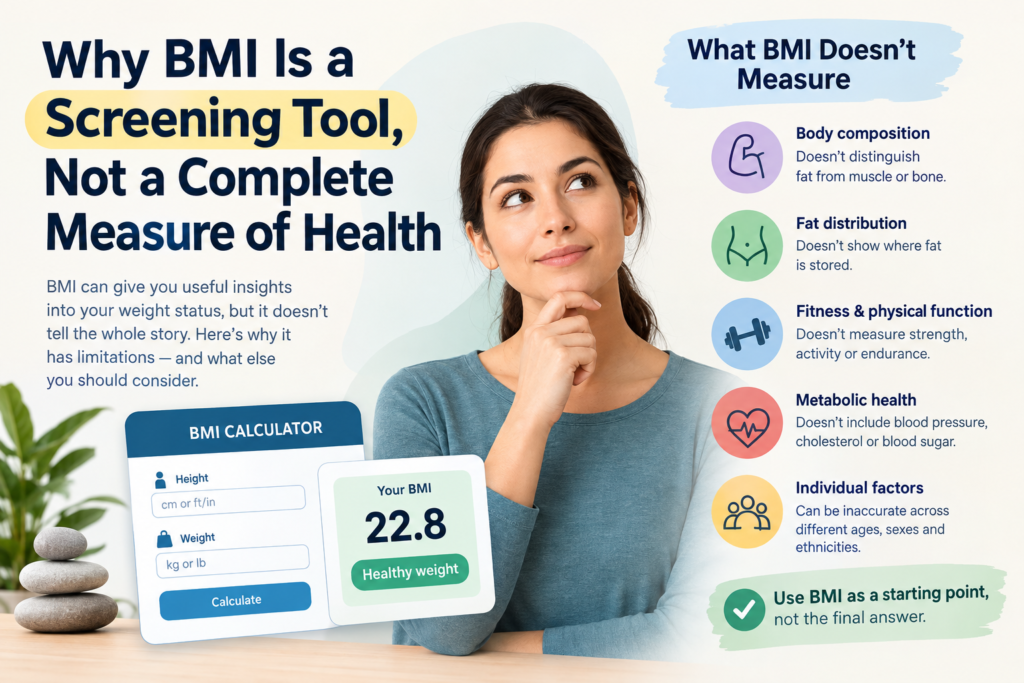
Why BMI Is a Screening Tool, Not a Complete Measure of Health
Why BMI Is a Screening Tool, Not a Complete Measure of Health
If you have searched for “BMI outdated” or wondered, “Is BMI outdated?”, you are not alone. BMI has been used for decades to classify weight and screen for possible health risks, but it has important limitations. It is a simple calculation based on height and weight, not a direct measurement of body fat, fitness, metabolic health, or overall well-being.
That does not mean BMI is useless. Major health organizations, including the CDC and NHLBI, continue to describe BMI as a useful screening measure. The important point is that BMI should be interpreted as one piece of health information rather than a complete assessment of an individual’s health.
Is BMI Outdated?
The answer depends on what you mean by “outdated.”
BMI itself is still widely used because it is inexpensive, quick, noninvasive, and easy to calculate. It can help identify people who may have a higher or lower weight relative to their height and is particularly useful for tracking weight patterns and studying population-level trends. The CDC continues to describe BMI as a screening measure rather than a diagnostic test.
What has changed is the understanding of how much BMI can tell us.
Using BMI as if it were a complete measure of health can be misleading. It does not distinguish muscle from fat, does not show where fat is stored, and does not directly measure metabolic or physical fitness. Research has also highlighted differences in how BMI relates to body composition and health risk across age, sex, ethnicity, and other characteristics.
So, rather than saying that BMI is completely outdated, it is more accurate to say that the overreliance on BMI is increasingly being questioned.
What Is BMI and What Does It Actually Measure?
Body mass index, or BMI, is a calculation based on a person’s weight and height:
BMI = weight in kilograms ÷ height in meters²
For adults, standard BMI categories are generally:
- Underweight: below 18.5
- Healthy weight: 18.5 to less than 25
- Overweight: 25 to less than 30
- Obesity: 30 or higher
The CDC uses these categories for adults aged 20 and older, while BMI is interpreted differently for children and teenagers using age- and sex-specific growth charts.
BMI therefore answers a relatively narrow question:
How does a person’s weight compare with their height?
It does not answer every question about that person’s health.
Why Is BMI Flawed?
The main problem with BMI is not the mathematics. The calculation is straightforward. The issue is what people sometimes assume the number represents.
BMI is often treated as an estimate of body fat or an indicator of overall health, but weight can come from several components, including muscle, bone, organs, and fat. Because BMI uses only height and total body weight, it cannot distinguish between these components.
For example, a muscular athlete may have a BMI in the overweight or obesity category because muscle contributes to body weight. At the other end of the spectrum, someone with a relatively normal BMI may still have a higher amount of body fat or abdominal fat that BMI does not reveal.
A 2024 review in the International Journal of Environmental Research and Public Health highlighted this limitation, noting that BMI does not measure body-fat distribution and can misclassify people with different body builds, including muscular individuals.
What Does BMI Not Take Into Account?
There are several important factors that a BMI calculation cannot capture.
Body Composition
BMI does not tell you how much of your body weight comes from fat versus lean tissue. Two people can have exactly the same BMI while having very different amounts of muscle and body fat.
More detailed body-composition methods, such as bioelectrical impedance analysis or DEXA, can provide information that BMI cannot. These methods are not always necessary for routine screening, but they illustrate why BMI should not be interpreted as a direct measurement of body fat.
Fat Distribution
Where fat is stored can matter for health. BMI does not indicate whether fat is concentrated around the abdomen or distributed elsewhere.
Measures such as waist circumference can provide additional information about abdominal fat and weight-related risk. The NHLBI specifically notes that waist circumference can be used alongside BMI when evaluating overweight and obesity.
Muscle Mass
Muscle weighs more than the same volume of fat. As a result, people who have substantial muscle mass can receive a higher BMI classification even when they do not have the amount of body fat that the category might imply.
This is one reason BMI can be misleading when used without considering body composition.
Fitness and Physical Function
BMI does not measure cardiovascular fitness, muscular strength, physical activity, mobility, or physical performance.
A BMI number cannot tell you whether someone regularly exercises, has good cardiorespiratory fitness, or has strong physical function.
Blood Pressure, Cholesterol, and Blood Glucose
BMI also does not measure important clinical markers such as blood pressure, cholesterol, or blood glucose.
The CDC recommends considering BMI alongside other information, including medical history, health behaviors, physical examination findings, and laboratory results.
Why Is BMI Inaccurate for Some People?
It is more accurate to say that BMI can be inaccurate or misleading in certain situations rather than saying that BMI is always inaccurate.
One reason is that the relationship between BMI, body fat, and health risk varies between individuals and populations.
Age, sex, ethnicity, body composition, and fitness can influence how a particular BMI relates to health. The 2024 review of BMI limitations notes that the relationship between BMI and body-fat percentage varies according to factors including age, sex, and ethnicity.
This means the same BMI number does not necessarily describe identical body composition or identical health risk for every person.
Is the BMI Scale Outdated?
The standard adult BMI scale remains widely used, but its limitations and the way its cutoffs are applied have been debated.
Historical research shows that BMI thresholds have changed across different periods and populations. Some populations have also been studied using different thresholds because the relationship between BMI and health risks can vary.
This is particularly relevant when applying one universal set of categories to diverse populations.
The American Medical Association has also acknowledged significant limitations in using BMI as a clinical measure and supports considering additional measures such as body composition, waist circumference, visceral fat, and metabolic factors.
That does not mean there is no value in the standard BMI scale. It means the scale should be understood as a screening framework, not a complete definition of a person’s health.
The Problem With BMI: One Number Cannot Describe Everything
A BMI result is attractive because it is simple.
You enter height and weight, perform one calculation, and receive one number.
The simplicity is one of BMI’s greatest strengths, but it can also become one of its biggest weaknesses when the number is given too much meaning.
For population health, simple measurements are extremely useful. Researchers and public-health organizations can use BMI to track changes in weight status across large groups of people over time. Its low cost and ease of measurement make it practical in settings where more sophisticated body-composition tests would be difficult or expensive.
For an individual, however, the question is more complicated.
A BMI result should be considered together with other relevant information rather than interpreted in isolation.
Can BMI Be Wrong?
Yes, BMI can give a misleading impression in some circumstances, but that does not make every BMI result wrong.
For example, a person with considerable muscle mass may have a high BMI without having an equivalent level of body fat. Conversely, an older adult with lower muscle mass could have a BMI that appears acceptable while BMI does not reveal the person’s full body composition. Research has identified both types of limitations when BMI is used as an individual measure.
This is why a BMI number should be treated as a starting point for understanding weight status rather than a final conclusion about health.
Is BMI Still Useful?
Yes.
Calling BMI completely outdated would overlook the reasons it remains widely used.
BMI is:
- Simple to calculate
- Inexpensive
- Noninvasive
- Easy to repeat
- Useful for monitoring changes over time
- Practical for population-level health research
- Useful as an initial screening measure
The CDC currently describes BMI as a quick, low-cost screening measure and emphasizes that it should be considered with other health information.
The 2024 peer-reviewed review provided for this topic similarly concluded that BMI retains value for population health and rapid clinical screening while acknowledging substantial limitations for individual risk prediction.
Therefore, the better question is not simply “Is BMI outdated?”
A more useful question is:
“How should BMI be used, and what information should be considered alongside it?”
What Should Be Considered Alongside BMI?
A more complete assessment can include several additional measures, depending on the person’s circumstances and the reason for the evaluation.
Waist Circumference
Waist circumference provides information about abdominal size and can add context that BMI cannot provide. It is particularly useful because BMI does not show where body fat is distributed.
Body Composition
Body-fat percentage and lean body mass can provide more information about what a person’s weight is made of.
Methods can include bioelectrical impedance analysis, skinfold measurements, and DEXA, although the appropriate method depends on the purpose, availability, and clinical setting.
Physical Fitness
Physical activity and cardiorespiratory fitness provide information that a BMI number cannot capture. Fitness can be relevant when assessing a person’s broader health and functional status.
Health Measurements
Blood pressure, blood glucose, cholesterol, medical history, lifestyle behaviors, and physical examination findings can all provide additional context. The CDC specifically recommends considering these types of information alongside BMI.
BMI Myths and Misconceptions
Myth: A High BMI Always Means a Person Has Too Much Body Fat
Not necessarily.
BMI does not distinguish muscle, bone, and fat. Someone with substantial muscle mass can have a high BMI without having the amount of body fat suggested by the category.
Myth: A Healthy BMI Proves Someone Is Healthy
A BMI in the healthy range does not measure every aspect of health. BMI does not directly assess fitness, blood pressure, cholesterol, glucose, body-fat distribution, or many other health factors.
Myth: BMI Is Completely Useless
That is also an oversimplification.
BMI remains useful as a screening measure and population-health indicator. Its limitations become important when it is treated as a complete individual assessment rather than one part of a broader evaluation.
So, Is BMI Outdated?
BMI is not simply an outdated measurement that should be ignored. It remains useful for screening and monitoring weight relative to height, particularly when used appropriately.
The concern is overreliance on BMI.
BMI does not directly measure body fat, distinguish muscle from fat, show fat distribution, measure fitness, or provide a complete picture of metabolic health. Its interpretation can also vary across different populations and individual circumstances.
For that reason, BMI is best viewed as one health screening tool rather than a complete measure of health.
If you use a BMI calculator, treat the result as a useful starting point. Your BMI can help you understand where your weight falls relative to your height, but a fuller picture may require other measurements and health information.
Frequently Asked Questions
Is BMI outdated?
BMI is not completely outdated. It remains a widely used screening measure because it is simple, inexpensive, and easy to apply. However, its limitations mean it should not be treated as a complete assessment of individual health.
Why is BMI flawed?
BMI is limited because it uses only height and weight. It cannot distinguish fat from muscle or bone, identify where fat is stored, or directly measure fitness and metabolic health.
Why is BMI inaccurate?
BMI can be misleading for some individuals because the relationship between BMI, body composition, and health risk varies. Muscular people are one common example.
Can BMI be wrong?
BMI can produce a classification that does not accurately reflect a person’s body composition or overall health. The result itself is mathematically calculated, but its interpretation may be incomplete.
What does BMI not take into account?
BMI does not directly account for body-fat distribution, muscle mass, bone mass, physical fitness, blood pressure, cholesterol, blood glucose, or many other aspects of health.
Is BMI still useful?
Yes. BMI remains useful as a screening measure and for monitoring population-level trends. It is most informative when interpreted alongside other relevant health measurements.
What is better than BMI?
There is no single replacement that provides every piece of information BMI lacks. Depending on the situation, waist circumference, body-composition measurements, physical fitness, medical history, blood pressure, blood glucose, cholesterol, and other clinical information can provide additional context.
Final Takeaway
The debate over whether BMI is outdated is really a debate about how BMI should be used.
BMI has clear strengths: it is simple, inexpensive, repeatable, and useful for screening. At the same time, it has well-documented limitations when used as a standalone measure of an individual’s body composition or health.