
Sound Proof Enclosures for Generators: Best Guide
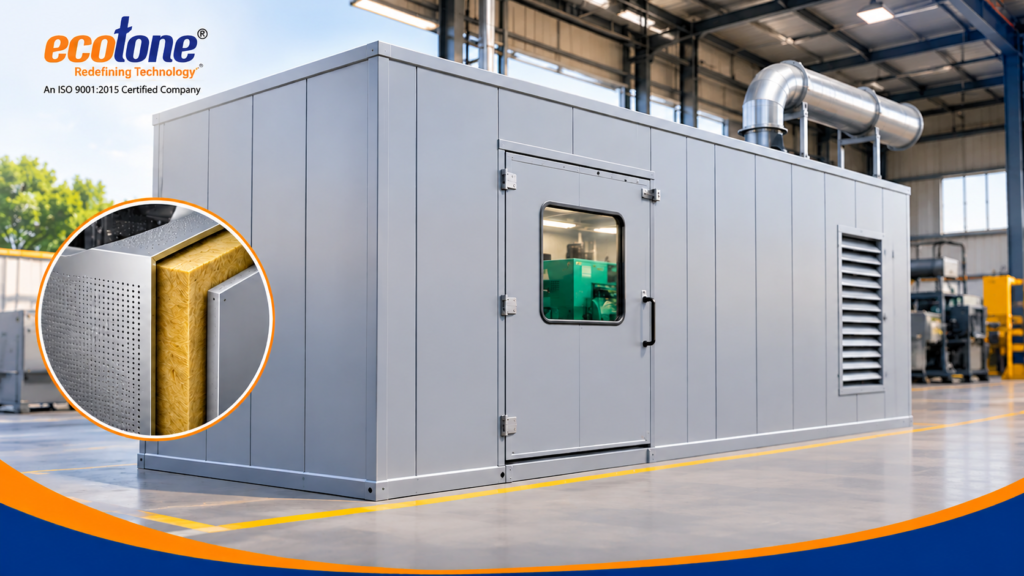
Sound proof enclosures are engineered housings that surround a generator to reduce the noise it radiates into the environment. They are used to meet community noise limits, protect workers from hearing damage, and keep sensitive operations undisturbed. The main standards involved are ISO 8528-10 for measuring generator-set airborne noise, ISO 3744 for sound power determination, and local rules such as India’s CPCB limits for diesel generator sets.
What the Term Means
“Acoustic” comes from the Greek akoustikos, meaning “of hearing,” and “enclosure” simply means a closed housing. A soundproof enclosure is therefore a structure built to control what is heard outside it. In practice, no enclosure blocks sound completely, so the more accurate engineering term is sound attenuation. A sound proof enclosure is a purpose-built housing that reduces airborne noise from a source, such as a generator, by absorbing, blocking, and damping sound energy before it reaches the surroundings.
A Simple Way to Picture It
Imagine shouting in a large empty hall. The sound bounces off bare walls and returns as an echo. Now imagine the same hall with thick curtains, carpet, and padded panels: your voice is swallowed and the echo disappears.
An acoustic enclosure works on the same principle. Dense outer walls stop sound from passing through, while absorbent lining inside prevents it from building up and bouncing around. The generator keeps running at full output, and far less noise escapes.
Where Sound Enclosures Are Used
Generator noise control matters across many sectors. Typical users include telecom towers and data centers, hospitals and laboratories, manufacturing plants, construction sites, commercial buildings, and residential complexes.
Different standards lead to different configurations. A hospital may need very low night-time noise at its boundary, while a telecom site may prioritise compact size and weather protection. A factory may care most about worker exposure inside the plant room. Each requirement changes the wall thickness, insulation density, and airflow design.
Common Types and Uses
Most projects fall into a handful of configurations. The main types are canopy enclosures for outdoor generators, containerised enclosures for portable or remote sites, walk-in plant-room enclosures, rooftop enclosures, silenced intake and exhaust enclosures, and custom-engineered units for special applications.
Canopy designs are the most common for standard diesel sets. Containerised units suit rental fleets and temporary power. Rooftop and plant-room solutions are chosen where space is limited and noise must be controlled close to occupants.
Standards and Technical Specifications
Several standards guide design and verification. ISO 8528-10 defines how to measure airborne noise from reciprocating generator sets, and ISO 3744 covers sound power measurement. ISO 7235 and ISO 11546 are used to evaluate silencers and enclosure performance. In the EU, Directive 2000/14/EC sets noise emission limits for outdoor equipment.
In India, the CPCB requires diesel generator sets to meet a limit of 75 dB(A) at 1 metre, or a minimum insertion loss of 25 dB(A). Typical commercial enclosures aim for 65 to 75 dB(A) at 1 metre. Premium designs can reach the low 60s, depending on engine size and airflow needs.
ACOUSTIC ATTENUATION AND AIRFLOW DESIGN
The core technology behind a good enclosure is a combination of mass, absorption, and controlled ventilation. Outer panels, usually galvanised or powder-coated steel of 1.2 to 2 mm, provide the mass to block sound transmission. Inside, mineral wool or polyurethane foam of 50 to 100 mm and 48 to 100 kg/m³ density absorbs mid- and high-frequency noise, often with a perforated or glass-tissue facing to protect it from oil and moisture.
The harder challenge is airflow. A generator needs large volumes of cooling and combustion air, and every opening is a path for sound. Acoustic louvres and attenuator splitters let air through while cutting noise, often by 20 to 30 dB. Low-frequency engine noise is the hardest to control, so it needs thicker absorption and well-designed exhaust silencers.
Practical tip: do not size an enclosure for noise alone. Check the airflow and back-pressure figures against the engine manufacturer’s limits, because an over-sealed enclosure can raise operating temperatures and cut generator output. Ask for measured noise data at defined distances, not just a single headline decibel figure.
Choosing the Right Solution
A reliable specification starts with generator capacity, site layout, noise limit at the boundary, and the local environment, including heat, dust, and humidity. Maintenance access, fuel tank integration, and fire safety should be settled early, since they are costly to change later.
Are you in the process of installing or choosing a soundproof enclosure, acoustic enclosures, a generator soundproof box, a sound proof generator enclosure, or a sound enclosure? Don’t hesitate to contact us. Our account managers and technical experts can help even if you are not yet sure what you need. We can review your generator details, site conditions, and compliance requirements and recommend a suitable approach.