
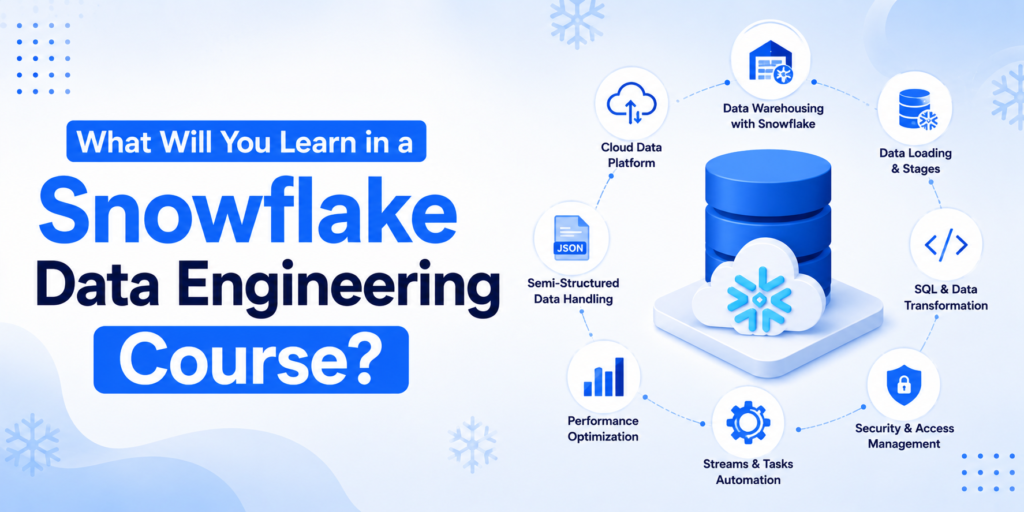

If you are planning to build a career in cloud data engineering, learning Snowflake can give you a strong foundation in modern data platforms. Snowflake Training in Chennai can help learners understand how data is stored, processed, transformed, and managed in a cloud-based environment. But what exactly should you expect to learn? Let’s walk through the important skills step by step.
1. Snowflake Fundamentals
The first step is understanding what Snowflake is and why organizations use it for data workloads.
You will learn about:
- Snowflake architecture
- Cloud data warehousing concepts
- Databases, schemas, and tables
- Snowflake account structure
- Worksheets and the Snowflake interface
- Different Snowflake editions and features
You’ll also understand how Snowflake differs from traditional databases and data warehouses. This foundation makes the advanced topics much easier to follow.
2. Snowflake Architecture
A good data engineer needs to understand what happens behind the scenes when data is processed. You will explore Snowflake’s architecture, including its separation of storage, compute, and cloud services. You’ll learn how these components work together and why this architecture makes it possible to scale computing resources independently.
This knowledge is especially useful when you start working with large datasets and performance optimization.
3. Virtual Warehouses and Compute
Virtual warehouses are an important part of working with Snowflake.
You will learn how to:
- Create and configure virtual warehouses
- Start and suspend warehouses
- Configure auto-suspend and auto-resume
- Scale compute resources
- Understand warehouse sizing
- Monitor warehouse usage
You’ll also learn how compute resources affect query performance and cost. This helps you make better decisions when designing data workloads.
4. Tables and Data Types
Next, you’ll work with different types of tables and data structures.
You can expect to learn about:
- Permanent tables
- Temporary tables
- Transient tables
- Views
- Common Snowflake data types
- Structured and semi-structured data
You’ll also practice creating tables, inserting records, updating data, and managing table structures using SQL.
5. Data Loading and Stages
Data engineering involves bringing data from different sources into a platform. Snowflake provides several options for loading data efficiently.
You’ll learn about Snowflake stages, including internal and external stages. You may also work with cloud storage services such as Amazon S3, Microsoft Azure Blob Storage, and Google Cloud Storage.
Other important topics include:
- File formats
- CSV and JSON files
- Bulk data loading
- COPY INTO
- Data validation
- Error handling during data loading
This section gives you practical knowledge of how raw data enters a Snowflake environment.
6. SQL and Data Transformation
SQL is a fundamental skill for anyone working as a Snowflake data engineer.
You’ll strengthen your understanding of:
- SELECT statements
- Joins
- Subqueries
- Common table expressions
- Window functions
- Aggregations
- Conditional logic
- Data cleansing
- Data transformation
Instead of simply learning SQL syntax, the focus should be on using SQL to solve real data problems.
7. Working with Semi-Structured Data
Modern applications generate data in formats such as JSON, Avro, and Parquet. Snowflake provides capabilities for working with these data formats.
You’ll learn how to query nested data, extract values, flatten arrays, and transform semi-structured information into useful datasets.
This is an important skill for data engineers because real-world data is rarely limited to simple relational tables.
8. ETL and ELT Pipelines
One of the major areas covered in Snowflake data engineering is building data pipelines.
You’ll understand the difference between ETL and ELT and learn how Snowflake can be used to transform and prepare data for analytics.
Typical pipeline concepts include:
Source → Ingestion → Staging → Transformation → Target Tables → Analytics
You’ll learn how each stage works and how data can move from raw sources to business-ready datasets.
9. Streams and Tasks
Automation is another important part of Snowflake data engineering. You’ll learn how Streams can help track changes in data and how Tasks can automate SQL-based operations. Together, these features can be used to build automated workflows and support incremental data processing.
For example, instead of processing an entire table every time, a pipeline can identify changed records and process only the required data.
10. Time Travel, Cloning, and Data Sharing
Snowflake also includes several features that simplify data management.
You’ll learn about:
- Time Travel
- Fail-Safe
- Zero-copy cloning
- Secure data sharing
- Database and schema cloning
- Data recovery concepts
These features are useful when developers need to test changes, recover previous data states, create development environments, or share data securely.
11. Performance and Cost Optimization
Knowing how to write a query is important, but knowing how to make it efficient is even more valuable.
You’ll explore topics such as:
- Query optimization
- Warehouse sizing
- Warehouse scaling
- Query monitoring
- Caching
- Clustering concepts
- Compute cost management
The goal is to understand how design and configuration decisions can influence both performance and cloud spending.
12. Security and Access Management
Data engineers also need to understand how data is protected. You’ll learn about Snowflake’s role-based access control, users, roles, privileges, and permissions. You may also explore concepts related to secure data sharing and data governance.
Understanding these areas helps you build data environments where users can access the information they need without unnecessarily exposing sensitive data.
13. Real-World Data Engineering Projects
Theory becomes much more useful when you apply it to practical scenarios.
A well-structured learning path can include projects such as:
- Retail sales data pipelines
- Customer analytics
- Healthcare data processing
- Financial data analysis
- Automotive data management
- E-commerce analytics
Working on projects helps you understand how ingestion, transformation, storage, automation, and analytics fit together in an actual workflow.
14. Career and Interview Preparation
Finally, you can connect your technical knowledge with practical career preparation. This may include working with real-world SQL problems, understanding common Snowflake scenarios, explaining data pipelines, and discussing project architecture during interviews.
Building a portfolio project can also help demonstrate that you understand more than just individual Snowflake features.
Conclusion
A Snowflake data engineering learning path covers much more than simply writing SQL queries. You can progress from Snowflake fundamentals and architecture to data loading, transformation, pipelines, automation, security, optimization, and real-world projects. With structured learning and practical experience, Qmatrix Technologies can be a useful option for learners looking to develop Snowflake and modern data engineering skills.