

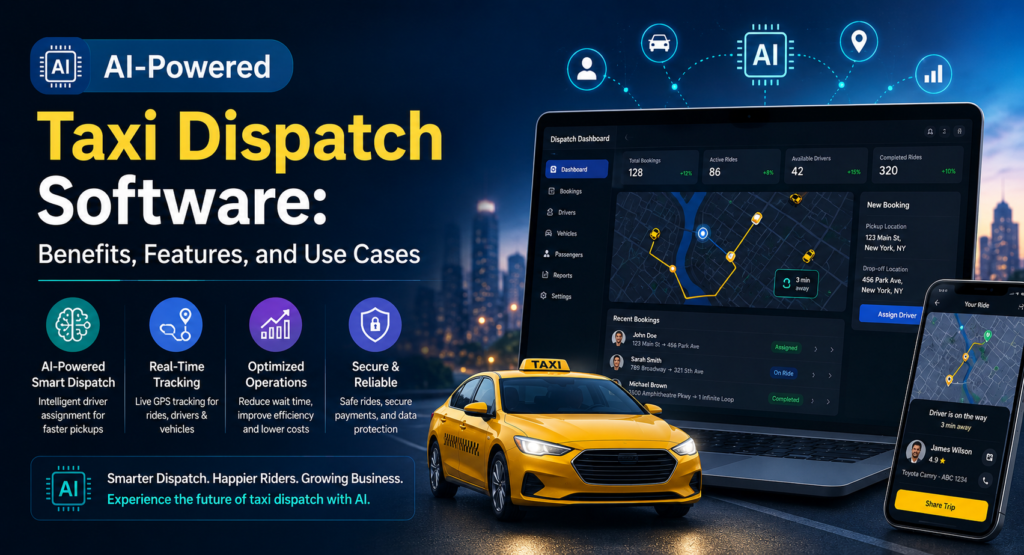

Taxi businesses are moving beyond conventional dispatch methods. Manual driver allocation, radio communication, and fragmented spreadsheets can become cumbersome as booking volumes increase. AI-powered taxi dispatch software introduces an intelligent operational layer that can analyze driver locations, availability, traffic conditions, booking patterns, and other variables to make faster dispatch decisions.
The result is a more responsive and data-driven taxi operation. Instead of merely assigning the nearest vehicle, modern systems can evaluate multiple conditions simultaneously to identify a more suitable driver and route.
How AI-Powered Taxi Dispatch Software Works
Intelligent Driver Allocation
When a passenger requests a ride, the dispatch engine evaluates available drivers using factors such as GPS proximity, vehicle category, driver status, estimated arrival time, and configured business rules. The most suitable driver can then receive the trip automatically.
Predictive Demand Analysis
AI can also examine historical booking patterns, time of day, locations, and recurring demand trends to anticipate where future requests may emerge. Operators can consequently position drivers before demand peaks rather than reacting after the booking surge begins.
Dynamic Route Optimization
Traffic congestion and road conditions can change within minutes. AI-enabled routing can combine live location data with traffic information to recommend more efficient routes and improve estimated arrival times.
Key Features of AI-Powered Taxi Dispatch Software
Real-Time GPS Tracking
A live fleet map gives dispatchers visibility into vehicle locations and statuses. This information forms the foundation for accurate allocation and operational coordination.
Automated Dispatch and Reassignment
If a driver declines or fails to respond to a booking, automated reassignment can transfer the request to another eligible driver. This reduces manual intervention and helps prevent missed bookings.
Driver and Fleet Management
A centralized dashboard can consolidate driver profiles, vehicle information, trip activity, availability, and operational performance. Such consolidation makes fleet oversight considerably less labyrinthine.
Analytics and Reporting
Performance dashboards can reveal booking volumes, driver utilization, response times, cancellations, revenue patterns, and other operational indicators. These insights help businesses make decisions based on evidence rather than intuition.
Benefits of AI-Powered Taxi Dispatch Software
The most significant advantage is operational efficiency. Automated dispatch can accelerate ride allocation while reducing the workload associated with manually coordinating every trip.
AI can also help decrease unnecessary vehicle movement by considering proximity and estimated travel time when selecting drivers. Better utilization can translate into fewer empty miles and more productive fleet hours.
For passengers, the benefits are equally tangible. Faster driver allocation, accurate ETAs, live tracking, and smoother communication can create a more predictable booking experience.
Use Cases of AI-Powered Taxi Dispatch Software
Taxi Fleet Operators
Taxi companies can use AI dispatch to coordinate growing fleets, automate routine allocation, and monitor vehicles through a centralized control panel.
Airport Transportation
Airport transfer businesses often deal with scheduled pickups, flight-related timing, and concentrated demand. Intelligent dispatch can help coordinate available vehicles around these operational fluctuations.
Corporate Transportation
Corporate transportation providers can use dispatch technology to manage scheduled employee rides, preferred vehicle categories, driver assignments, and service-level requirements.
Private-Hire and Chauffeur Services
Premium transportation companies can apply intelligent dispatch while retaining manual control for VIP bookings, specialized vehicles, or priority customers.
Why AI Matters for the Future of Taxi Operations
AI is transforming dispatch from a reactive function into a more anticipatory system. Instead of simply responding to bookings, intelligent platforms can identify patterns, optimize allocation, and support operational forecasting. Current taxi-dispatch solutions increasingly combine AI, GPS, analytics, cloud management, and automated workflows into unified platforms.
This evolution allows taxi businesses to scale without allowing operational complexity to expand at the same pace.
Conclusion
AI-powered taxi dispatch software can help transportation businesses automate driver allocation, optimize routes, improve fleet utilization, and deliver more consistent passenger experiences. With capabilities such as predictive demand analysis, real-time tracking, automated reassignment, and intelligent analytics, it provides a technological foundation for modern taxi operations. Businesses seeking to build a scalable and customizable dispatch ecosystem can consider spotnrides for developing an AI-powered taxi dispatch solution tailored to their operational requirements.