
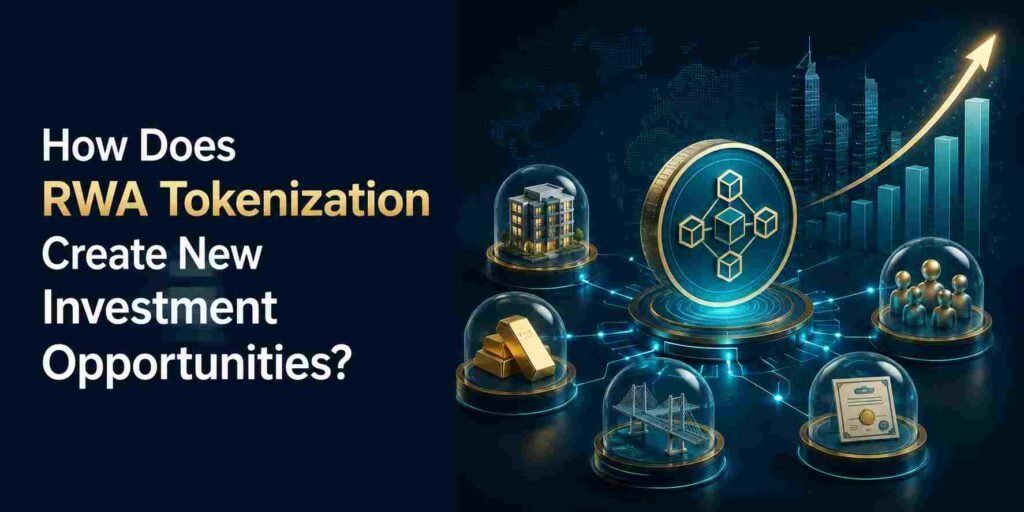

Real-world asset (RWA) tokenization is emerging as one of the most significant applications of blockchain technology in modern finance. Instead of representing ownership, economic rights, or claims through conventional certificates, contracts, fund records, or centralized databases, tokenization converts those rights into blockchain-based digital tokens. These tokens can represent assets such as real estate, government bonds, private credit, commodities, artwork, infrastructure, investment funds, and other financial instruments.
The investment opportunity created by RWA tokenization is not simply about putting traditional assets on a blockchain. Its larger significance comes from changing how assets can be accessed, divided, transferred, settled, and managed. Fractional ownership can reduce minimum investment requirements, programmable transactions can automate parts of the investment lifecycle, and blockchain-based records can improve transparency and operational efficiency. The Bank for International Settlements (BIS) identifies improved efficiency, lower costs, greater transparency, and broader investor access through fractionalization among the potential benefits of tokenization, while also emphasizing that these benefits come with regulatory and operational challenges.
The market opportunity is also becoming increasingly substantial. McKinsey estimates that tokenized financial assets could reach approximately $2 trillion in market capitalization by 2030 in its base case, excluding cryptocurrencies and stablecoins, with an optimistic scenario approaching $4 trillion. This growth suggests that RWA tokenization could become an important component of future investment infrastructure rather than remaining a niche blockchain experiment.
What Is RWA Tokenization?
RWA tokenization is the process of creating blockchain-based tokens that represent ownership, economic interests, or contractual claims connected to an underlying real-world asset. The physical or traditional asset does not necessarily disappear from the existing financial system. Instead, blockchain infrastructure provides a digital representation of the relevant rights and enables those rights to be managed through programmable systems.
For example, consider a commercial property valued at $10 million. Under a traditional ownership structure, an investor may need substantial capital to acquire a direct interest in the property. Through an appropriately structured tokenization model, the economic interests associated with the property could potentially be divided into a large number of digital units. Investors could then acquire smaller interests rather than purchasing the entire property.
The same principle can apply to bonds, private credit, investment funds, commodities, infrastructure projects, and other assets. However, tokenization does not automatically make an asset more valuable or liquid. The legal structure connecting the token to the underlying asset, the rights of token holders, custody arrangements, compliance procedures, and the existence of a functioning secondary market are all critical.
The SEC has emphasized that tokenized securities remain securities when they meet the applicable legal definition, meaning tokenization does not eliminate securities-law obligations.
Fractional Ownership Opens Access to Previously Expensive Assets
One of the clearest ways RWA tokenization creates new investment opportunities is through fractional ownership.
Traditional investments often require significant amounts of capital. Commercial real estate, private equity, fine art, infrastructure, and certain private credit opportunities can be difficult for smaller investors to access because of high minimum investments, administrative expenses, geographic restrictions, and complicated transaction processes.
Tokenization can divide an investment into smaller units. Instead of one investor purchasing an entire asset, numerous eligible investors can potentially own smaller economic interests. This does not necessarily mean that every tokenized asset becomes available to every investor; regulatory restrictions, investor accreditation requirements, jurisdictional rules, and offering structures still matter. Nevertheless, reducing investment denominations can substantially broaden participation.
The BIS has specifically highlighted fractionalization as a mechanism through which tokenization can allow investors to hold portions of assets such as property that they might otherwise be unable to afford.
This creates an important portfolio effect. An investor with $100,000 does not necessarily have to commit the entire amount to one property or private asset. Subject to the applicable structure and market availability, smaller tokenized positions could allow the investor to distribute capital across multiple properties, debt instruments, funds, commodities, or other assets.
Consequently, tokenization can shift investment behavior from ownership of a few large positions toward more granular portfolio construction.
Real Estate Becomes a Major Use Case
Real estate provides one of the clearest examples of how tokenization can create new investment opportunities because property markets traditionally involve high transaction costs, large capital requirements, lengthy settlement processes, and limited liquidity.
A BIS working paper published in 2025 and revised in 2026 analyzed tokenized real estate using U.S. data from 2019–25. It found that tokenized properties tended to emerge in areas characterized by lower property prices, weaker demand, and lower liquidity. The research also found evidence that tokenization may help address gaps in access to real estate investment, particularly in regions with limited access to traditional credit.
The study provides an especially interesting observation concerning liquidity. Following natural-disaster declarations, trading in tokenized properties increased by 35% cumulatively over the following two days. However, the researchers noted that this liquidity benefit depended on platform-level buyback mechanisms, which can introduce additional solvency risks.
This illustrates an important principle: tokenization can improve the structure of an investment market, but liquidity ultimately depends on actual buyers, sellers, market infrastructure, legal rights, and liquidity mechanisms. A token does not automatically create a liquid market.
Global Access Can Expand the Investor Base
Another investment opportunity comes from the potential for digital distribution.
Traditional investments frequently depend on geographical infrastructure. An investor may need a local brokerage account, bank relationship, intermediary, or physical presence to participate in an asset market. Blockchain-based systems can potentially distribute investment instruments digitally across jurisdictions, provided that issuers and platforms comply with applicable laws.
Tokenization therefore has the potential to connect investors with opportunities beyond their traditional geographic markets. For example, an appropriately regulated investment platform could allow eligible investors in different jurisdictions to participate in a tokenized fund or asset offering through digital onboarding and blockchain-based ownership records.
This global accessibility can be particularly valuable for alternative investments that historically operated through specialized networks of banks, funds, brokers, and private intermediaries.
However, global accessibility should not be confused with unrestricted access. Securities regulations, tax rules, anti-money-laundering requirements, know-your-customer procedures, sanctions requirements, investor eligibility rules, and transfer restrictions can all determine who is legally permitted to purchase or transfer a tokenized asset.
Improved Liquidity and Secondary-Market Potential
Liquidity is another major area where RWA tokenization can create investment opportunities.
Many real-world assets are difficult to trade. Selling a property can take months, while private-market investments may have lock-up periods lasting years. Artwork, infrastructure investments, private credit, and other alternative assets can face similar limitations.
Tokenization can make ownership records easier to transfer and can support automated settlement. BIS research explains that tokenization can place asset information, ownership records, and transaction rules on programmable platforms, creating opportunities for automated transfers and more efficient settlement.
In an appropriately regulated secondary market, investors could potentially transfer tokenized interests more efficiently than through conventional paperwork-heavy processes. Blockchain-based settlement can also reduce reconciliation between multiple databases because participants can rely on a shared transaction record.
Nevertheless, secondary-market liquidity remains dependent on market participation. If there are no buyers, tokenization alone cannot guarantee that an investor can sell immediately at a desirable price.
Programmability Creates New Investment Structures
Perhaps the most transformative feature of RWA tokenization is programmability.
Traditional financial assets generally depend on multiple intermediaries to calculate payments, update ownership records, enforce restrictions, and complete administrative processes. Smart contracts can automate some of these activities according to predefined rules.
For example, a tokenized bond could be designed to automate coupon calculations and payments. A tokenized real estate investment could potentially distribute rental income according to predefined ownership percentages. A private-credit instrument could automate certain repayment processes. Transfer restrictions can also be encoded into token systems where the regulatory and technical architecture supports such functionality.
The BIS describes tokenization as combining information about an asset with rules and logic governing transfers, allowing transactions to become programmable and enabling mechanisms such as delivery-versus-payment.
This programmability creates investment structures that are difficult or expensive to implement using conventional systems. Investors could potentially receive automated distributions, while issuers could manage ownership records and compliance rules through integrated infrastructure.
Greater Transparency Can Improve Investor Confidence
Transparency is another potential advantage.
In traditional markets, investors may depend on multiple intermediaries to verify ownership, transaction history, settlement status, and other information. Blockchain networks can provide a shared record of transactions, potentially making certain information easier to verify.
For tokenized assets, this can improve operational transparency between issuers, custodians, investors, administrators, and other participants. Instead of repeatedly reconciling separate databases, participants can potentially interact with a common ledger.
This does not mean every aspect of an RWA investment becomes automatically transparent. Information about the physical asset, valuation, legal ownership, financial performance, and off-chain agreements may still depend on trusted third parties. The blockchain can accurately record a token while the underlying asset or legal claim still requires external verification.
Therefore, effective RWA tokenization combines blockchain transparency with strong asset verification, custody, legal documentation, audits, and governance.
New Opportunities for Institutional Investors
RWA tokenization is not limited to retail participation. Institutional investors may benefit from the technology through more efficient capital markets infrastructure.
Banks, asset managers, private-credit firms, fund administrators, and other institutions can use tokenization to experiment with faster settlement, automated compliance, fractional fund interests, collateral mobility, and digitally native financial products.
McKinsey expects tokenization adoption to develop in waves, with cash and deposits, bonds and exchange-traded products, mutual funds and ETFs, loans, and securitization among the asset classes with strong potential for adoption.
For institutions, the opportunity is therefore less about simply creating a cryptocurrency and more about modernizing financial-market infrastructure.
A tokenized asset can potentially connect issuance, distribution, settlement, custody, compliance, and servicing within a more integrated digital environment. This could reduce operational friction and make certain financial products easier to administer at scale.
RWA Tokenization Can Support Portfolio Diversification
Portfolio diversification is another significant investment opportunity.
Investors traditionally diversify across stocks, bonds, real estate, commodities, and other financial instruments. Tokenization could potentially make smaller allocations to alternative assets easier to implement.
For example, an investor might allocate smaller amounts to several tokenized real estate projects rather than committing substantial capital to one property. Another investor could potentially combine tokenized bonds, private-credit instruments, commodity interests, and fund units within a digitally managed portfolio.
This approach could make alternative-asset diversification more accessible, although investment suitability, correlation, valuation risk, liquidity, and regulatory eligibility must still be evaluated carefully.
What Are the Risks and Limitations?
The growth of RWA tokenization should not be interpreted as a guarantee of higher returns or lower investment risk.
The first challenge is regulatory uncertainty. Tokenized securities can remain subject to securities laws, disclosure requirements, custody rules, transfer restrictions, and investor-protection obligations. The SEC has stated that tokenized securities can have different structures and holder rights, while emphasizing that applicable securities laws continue to matter.
The second challenge is the connection between the digital token and the physical or traditional asset. If a token represents a property, investors need legally enforceable rights connected to that property. If a token represents a bond or fund interest, the underlying legal claim must be clearly defined.
Technology introduces additional risks, including smart-contract vulnerabilities, wallet security, oracle failures, interoperability problems, and operational weaknesses. Liquidity can also be overstated when tokenized assets have few active buyers.
The BIS has similarly warned that tokenization can involve trade-offs involving operational complexity, liquidity pressures, and regulatory uncertainty.
For investors, due diligence therefore remains essential. The blockchain infrastructure should be considered alongside the underlying asset, issuer, legal structure, custody model, valuation methodology, compliance framework, and secondary-market arrangements.
The Future of RWA Investment Opportunities
The future of RWA tokenization is likely to involve a gradual integration of blockchain infrastructure with existing financial markets rather than an overnight replacement of traditional systems.
As regulatory frameworks mature and institutions develop reliable custody, compliance, settlement, and interoperability infrastructure, tokenized assets could become increasingly integrated into mainstream investment platforms.
The most valuable opportunities may ultimately emerge where tokenization solves genuine market problems: lowering unnecessary transaction costs, reducing investment minimums, improving settlement, enabling more efficient collateral management, creating programmable financial products, and expanding access to suitable investment opportunities.
The technology is already moving beyond theoretical discussions. McKinsey’s projection of approximately $2 trillion in tokenized market capitalization by 2030 illustrates the scale of the potential market, while research from BIS demonstrates that tokenization is already producing measurable effects in areas such as real estate.
The key question is therefore no longer whether assets can technically be tokenized. The more important question is whether tokenization creates a better economic, legal, and operational structure for a particular asset.
Conclusion
RWA tokenization creates new investment opportunities by making traditionally illiquid or inaccessible assets more divisible, programmable, transferable, and digitally accessible. Fractional ownership can lower entry barriers, tokenized markets can support broader investor participation, and smart contracts can automate parts of the investment lifecycle. Real estate, private credit, bonds, funds, commodities, and other assets could benefit as the supporting infrastructure develops. At the same time, investors must recognize that tokenization does not remove underlying market, regulatory, liquidity, valuation, or technology risks. Successful adoption will depend on connecting blockchain technology with legally enforceable ownership rights, compliant investment structures, secure custody, reliable asset verification, and functioning markets. Businesses seeking to build these ecosystems can work with experienced technology providers offering RWA tokenization services and a comprehensive RWA tokenization solution; Blockchain App Factory also provides best-in-class RWA tokenization development services, helping businesses design secure, scalable, and feature-rich tokenization platforms aligned with their asset and business requirements.