
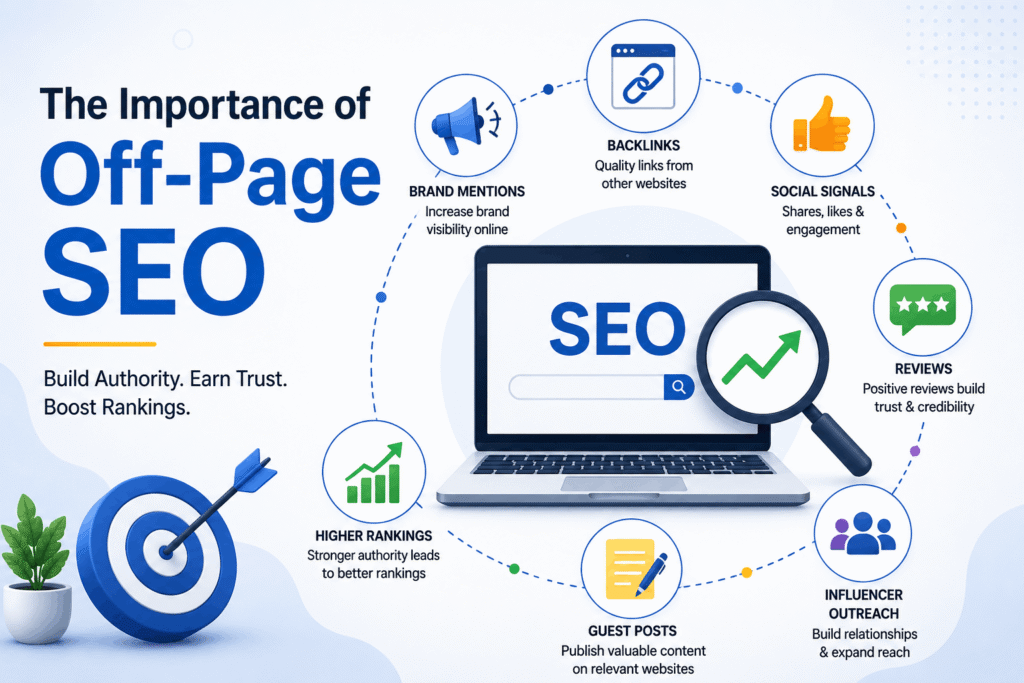

When it comes to improving a website’s visibility on search engines, SEO is not limited to what happens on your website. While on-page SEO focuses on optimizing content, keywords, headings, and other website elements, off-page SEO focuses on activities outside your website that can improve its authority, reputation, and search visibility.
A strong off-page SEO strategy can help search engines understand that your website is trustworthy and valuable within its industry. For businesses competing for difficult keywords, off-page SEO can play an important role in building long-term organic visibility.
What Is Off-Page SEO?
Off-page SEO refers to activities performed outside your own website to improve its search engine rankings and online reputation.
The most well-known part of off-page SEO is link building. When reputable and relevant websites link to your content, those links can act as signals of trust and authority.
However, off-page SEO is broader than backlinks. It can include digital PR, brand mentions, content promotion, relationship building, reviews, social media visibility, and other activities that help establish your website or brand as a credible source.
Why Is Off-Page SEO Important?
1. Builds Website Authority
Search engines need signals to determine which websites deserve visibility in competitive search results.
When authoritative and relevant websites mention or link to your website, they can help strengthen your website’s overall authority.
For example, if a respected marketing publication references an informative article published by your digital marketing agency, that mention can provide additional credibility and potentially bring referral traffic.
Building authority generally takes time. It requires consistently publishing useful content and earning recognition from relevant sources rather than relying on a large number of low-quality links.
2. Helps Improve Search Rankings
Backlinks remain an important part of how search engines discover and evaluate websites.
When high-quality websites link to your pages, those links can contribute to your site’s ability to compete for relevant search queries. However, not every backlink has the same value.
A relevant link from a trustworthy website can be much more useful than hundreds of unrelated or low-quality links.
Therefore, successful off-page SEO focuses on quality, relevance, and natural link acquisition rather than simply increasing the number of backlinks.
3. Increases Brand Awareness
Off-page SEO can help people discover your brand outside search engine results.
Guest articles, digital PR, industry publications, podcasts, interviews, online communities, and social media can introduce your business to new audiences.
Even when an external mention does not directly generate a ranking benefit, it can increase brand recognition. As more people become familiar with your brand, they may search for your company directly, visit your website, or recommend your services to others.
4. Generates Referral Traffic
Backlinks are not valuable only because of their potential SEO benefits.
A link placed on a relevant website can send visitors directly to your website.
For example, imagine a business website is mentioned in an industry blog that receives thousands of relevant visitors every month. Readers who find the recommendation useful may click the link and visit the business website.
This can generate highly targeted referral traffic and potentially lead to enquiries, leads, or sales.
5. Supports Online Reputation
Your online reputation can influence how customers perceive your business.
Positive mentions from reputable publications, industry websites, customers, and business communities can help establish credibility.
For service-based businesses, reputation is especially important. Potential customers often research a company before making a purchase decision. Seeing positive mentions, reviews, expert contributions, and industry recognition can make a business appear more trustworthy.
Important Off-Page SEO Strategies
1. High-Quality Link Building
Link building is one of the core components of off-page SEO.
The objective should be to earn links from websites that are:
- Relevant to your industry
- Trustworthy and established
- Useful to your target audience
- Editorially willing to reference your content
Some common approaches include creating link-worthy resources, digital PR, expert contributions, guest posting where appropriate, and building relationships with relevant publishers.
Avoid buying large numbers of low-quality backlinks or participating in manipulative link schemes. These approaches can create SEO risks instead of sustainable growth.
2. Digital PR
Digital PR combines public relations with online marketing.
Businesses can create newsworthy stories, research, reports, expert opinions, original statistics, or useful resources that journalists and publishers may want to reference.
For example, a digital marketing company could publish original research about website performance trends. If industry publications reference the research, the company may gain brand exposure and valuable editorial mentions.
3. Brand Mentions
Not every valuable off-page signal needs to be a traditional backlink.
When websites, publications, communities, or industry professionals mention your brand, they can increase your visibility and credibility.
Building a recognizable brand can also encourage more people to search for your business by name.
4. Guest Contributions
Contributing useful, original content to relevant websites can help businesses reach new audiences.
However, guest posting should not be treated simply as a way to create backlinks. The primary goal should be providing genuine value to the publication’s readers.
A well-written expert article can demonstrate knowledge, build relationships, increase brand awareness, and potentially generate referral traffic.
5. Social Media Promotion
Social media activity is another way to distribute content and increase brand visibility.
Social signals are not simply a direct substitute for backlinks, but social platforms can help your content reach more people. When useful content gains visibility, it may attract journalists, bloggers, creators, or website owners who could eventually reference it.
For this reason, social media can indirectly support an off-page SEO strategy.
6. Online Reviews and Reputation Management
Reviews are particularly important for businesses that serve customers directly.
Positive reviews can improve consumer trust and influence purchasing decisions. Maintaining a strong online reputation also gives potential customers additional reasons to choose your business.
Businesses should encourage genuine customer feedback and respond professionally to both positive and negative reviews.
Off-Page SEO vs. On-Page SEO
On-page and off-page SEO work together.
On-page SEO focuses on improving elements within your website, such as:
- Content
- Keywords
- Headings
- Title tags
- Meta descriptions
- Internal links
- Images
- URLs
Off-page SEO focuses on building authority and visibility outside your website through activities such as:
- Backlinks
- Digital PR
- Brand mentions
- Guest contributions
- Content promotion
- Reviews
- Industry relationships
A website with excellent content but no authority-building strategy may struggle to compete for highly competitive topics. Similarly, a website with many backlinks but poor content and user experience may not satisfy visitors.
A balanced SEO strategy therefore considers both sides.
How to Build a Sustainable Off-Page SEO Strategy
The best approach is to focus on long-term value rather than quick results.
Start by creating useful content that people genuinely want to reference. Research your competitors to understand where their backlinks and mentions come from. Identify relevant websites, publications, journalists, creators, and industry communities.
Then develop relationships and promote your content naturally.
Track important metrics such as referring domains, quality backlinks, referral traffic, brand mentions, organic visibility, and conversions. This helps you understand whether your off-page activities are contributing to real business outcomes.
Conclusion
Off-page SEO is an important part of a complete search engine optimization strategy. It helps businesses build authority, strengthen their online reputation, increase brand awareness, generate referral traffic, and compete more effectively in search results.
However, effective off-page SEO is not about collecting as many backlinks as possible. Quality and relevance matter more than quantity.
By creating valuable content, earning genuine mentions, building relationships with relevant websites, using digital PR, promoting content, and maintaining a strong online reputation, businesses can develop a sustainable off-page SEO strategy.
When combined with strong on-page SEO and technical SEO, off-page optimization can provide a solid foundation for long-term organic growth.