

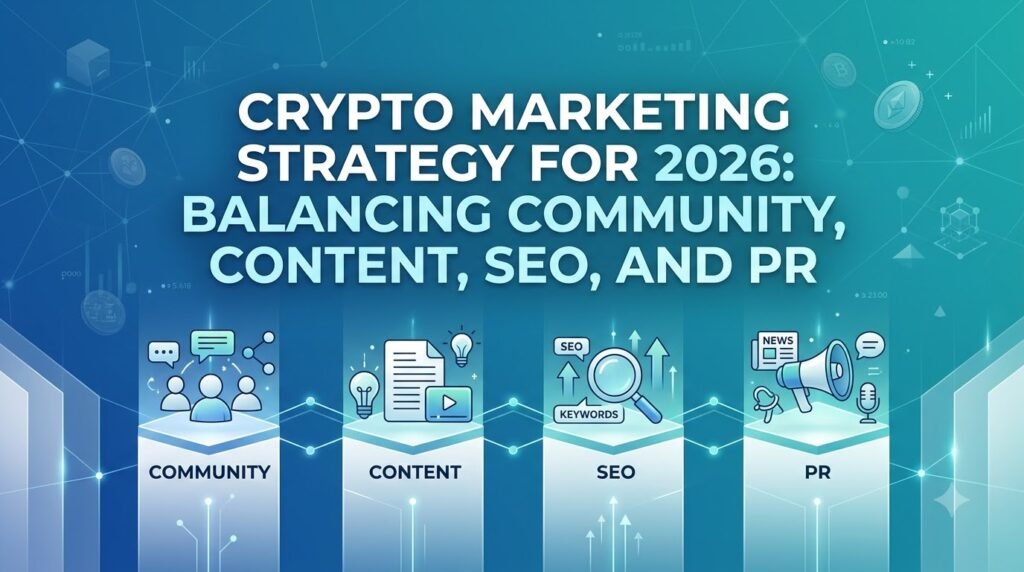

Crypto marketing in 2026 requires more than visibility. Projects now compete for attention across social platforms, search engines, crypto media, community channels, and increasingly sophisticated investor audiences. The challenge is not simply reaching more people, but building enough credibility for those people to stay, participate, and eventually become users.
The market itself has become broader and more diverse. Chainalysis ranked India first in its 2025 Global Crypto Adoption Index, while APAC recorded a 69% year-over-year increase in on-chain crypto value received, reaching approximately $2.36 trillion. These figures indicate a growing addressable audience, but they also highlight the need for region-specific messaging and stronger communication strategies.
A successful 2026 crypto marketing strategy should therefore connect four major functions: community, content, SEO, and PR. Each serves a different purpose, but the strongest results come when they operate as one system rather than as isolated marketing activities.
Why Crypto Marketing Needs a More Integrated Strategy in 2026
Crypto audiences are increasingly exposed to similar claims, token announcements, influencer promotions, partnership announcements, and technical narratives. This creates an attention problem. A project may generate thousands of impressions without creating meaningful interest or long-term participation.
At the same time, the audience itself has changed. Crypto adoption is no longer limited to early adopters and speculative traders. Institutional participation has expanded, while users in emerging markets continue to adopt crypto for payments, savings, remittances, and access to financial services. Chainalysis found that APAC was the fastest-growing major region in its 2025 analysis, while India ranked first globally in its adoption index.
Single-channel marketing is increasingly ineffective. Social media builds awareness, SEO captures active interest, content explains the project, and PR adds credibility. Crypto marketing agencies like Blockchain App Factory can coordinate these channels to promote crypto projects, grow communities, and maintain consistent market visibility.
The objective is not to make every channel equally important. Instead, marketers should assign each channel a clear role within the user’s journey.
Community Should Be the Foundation
Community remains one of the strongest assets available to a crypto project because blockchain products often depend on participation. Token holders, developers, traders, users, governance participants, and supporters can all influence how a project develops.
However, community size is a weak measure of marketing success on its own. A Telegram group with 200,000 members may produce less value than a smaller community where members regularly test products, attend governance discussions, provide feedback, and refer other users.
The focus in 2026 should shift from member accumulation to meaningful participation.
A strong community strategy begins with clear segmentation. Investors may want tokenomics and market information. Developers may care about documentation, grants, APIs, and technical updates. Users may care about product features and incentives. Community managers should understand these different motivations rather than communicating with everyone through the same message.
Regular communication also matters. Product updates, educational sessions, AMAs, governance discussions, community calls, and transparent development reports give members reasons to remain active. More importantly, projects should acknowledge criticism instead of treating every negative comment as a threat.
Trust grows when communities see consistent communication during both positive and difficult periods.
Content Should Explain, Not Just Promote
Content marketing has become particularly important as crypto products become more technically complex. A potential user may need to understand a protocol, token utility, staking model, security architecture, governance mechanism, or regulatory limitation before deciding whether to participate.
This creates an opportunity for projects that publish genuinely useful information.
Instead of producing repetitive announcements, a strong content program can cover several layers of the user’s decision process:
- Educational content explains concepts, mechanisms, and use cases.
- Technical content demonstrates how the product works and addresses developer questions.
- Research content examines market trends, data, and industry developments.
- Product content explains features through practical examples rather than promotional claims.
- Community content highlights discussions, contributions, events, and ecosystem activity.
The strongest content should also have a point of view. Simply rewriting information already available elsewhere provides limited value. Original research, first-hand product experience, expert commentary, data analysis, and transparent methodology can make content substantially more useful.
Google’s current guidance explicitly emphasizes helpful, reliable, people-first content and asks whether publishers provide original information, research, or analysis beyond what already exists. It also recommends clear authorship and evidence of expertise, particularly for topics that can affect financial decisions.
For crypto companies, this is especially relevant. Publishing an article about token investments without explaining risks, assumptions, sources, and limitations can damage credibility even if the article initially attracts traffic.
SEO Should Capture Existing Demand
SEO should not be treated as a separate traffic-generation exercise. Its greatest value comes from connecting a project with people who are already looking for information.
Search behavior in crypto covers a wide range of intent. Someone may search for a general explanation of a blockchain concept, compare competing protocols, investigate a token, look for documentation, or search for a specific product.
A useful SEO strategy therefore organizes content around user intent rather than simply targeting a list of keywords.
For example, a blockchain project could build interconnected content around:
Awareness: What is tokenized real-world infrastructure?
Education: How does RWA tokenization work?
Evaluation: RWA tokenization platforms compared
Product: How the project’s protocol handles tokenized assets
Conversion: Developer documentation, onboarding, or application pages
This structure creates a path from discovery to product engagement.
Technical SEO still matters, including crawlability, internal linking, page structure, metadata, structured information, mobile usability, and performance. But technical optimization cannot compensate for weak information. Google’s Search Essentials specifically recommends helpful, reliable, people-first content and using language that matches how users search.
Crypto brands should also treat author credibility seriously. Byline information, author expertise, citations, original research, transparent methodology, and links to supporting documentation can strengthen the perceived reliability of financial and technical content.
PR Should Build Third-Party Credibility
Owned content tells audiences what a project says about itself. PR introduces independent voices into the conversation.
This distinction is important because crypto audiences are often skeptical of self-published claims. A project announcing its own partnership is one thing. A reputable publication independently reporting on that partnership, explaining its relevance, and quoting credible participants creates a different level of visibility.
Effective crypto PR in 2026 should focus on newsworthiness rather than simply purchasing exposure.
Strong PR opportunities can include:
- Major product releases with measurable user impact
- Meaningful partnerships with established organizations
- New research or industry data
- Security improvements and audit announcements
- Significant ecosystem integrations
- Regulatory or market commentary from qualified experts
- Funding announcements with clear strategic relevance
The goal should be to give journalists and industry publications something useful to report.
PR also supports SEO indirectly. Coverage can introduce a project to new audiences, create branded search demand, generate references across the web, and provide additional material for social and community distribution.
The Four Channels Should Work as One System
The biggest strategic mistake is treating community, content, SEO, and PR as four independent departments.
A better approach is to create a content and distribution loop.
Suppose a project publishes original research about stablecoin adoption. The research becomes a long-form report on the website. SEO-optimized articles explain its major findings. Short insights are distributed on X and LinkedIn. Community managers discuss the findings in Telegram or Discord. The research is then pitched to relevant journalists. Any media coverage is shared back with the community and incorporated into future content.
One research asset can therefore support multiple channels without simply duplicating the same message.
This approach also improves efficiency. Instead of creating dozens of unrelated posts every month, marketing teams can develop fewer high-value assets and distribute their insights across multiple formats.
CoinGecko’s 2025 industry report illustrates why this matters. Its analysis found that the 20 leading crypto categories accounted for 67.7% of user attention, with meme coins and AI-related categories dominating mindshare. At the same time, the distribution of attention became broader than in 2024.
For marketers, this means attention can shift quickly. A durable strategy should therefore build an identifiable brand and information ecosystem rather than depend entirely on whatever narrative happens to trend.
Measure Quality, Not Just Reach
Crypto marketing dashboards often emphasize impressions, followers, website traffic, and community members. These metrics are useful, but they do not necessarily demonstrate business impact.
A more meaningful measurement framework should connect awareness with behavior.
For community, track active members, participation rates, retention, contributor growth, referrals, and event engagement.
For content, evaluate organic traffic, engaged sessions, returning visitors, content-assisted conversions, documentation usage, and newsletter or community sign-ups.
For SEO, monitor rankings, qualified organic traffic, branded searches, impressions, click-through rates, and conversions from high-intent queries.
For PR, measure quality coverage, referral traffic, branded search growth, journalist interest, backlinks where relevant, and the downstream engagement generated by coverage.
The most important question is not “How many people saw the campaign?” but “What happened after they saw it?”
A campaign that generates fewer impressions but produces active users, developers, contributors, or qualified investors can be more valuable than a campaign that produces millions of passive views.
A Practical 2026 Execution Model
A practical strategy can be organized into three stages.
First, establish credibility. Build clear positioning, strong website content, technical documentation, transparent project information, active community channels, and authoritative foundational content.
Second, build consistent attention. Publish research, educational articles, product updates, community discussions, social content, and selected PR campaigns around a common set of themes.
Third, strengthen distribution. Repurpose high-performing content, develop relationships with relevant media and industry voices, expand search visibility, and use community feedback to determine future content priorities.
The important point is sequencing. PR should not be used to compensate for an incomplete product narrative. SEO should not be expected to fix poor messaging. Community growth should not be pursued before the project gives users a reason to participate.
Each function should strengthen the others.
Conclusion
Crypto marketing in 2026 is increasingly a credibility-building exercise rather than a race for impressions. Community creates participation, content creates understanding, SEO captures existing demand, and PR provides third-party validation. When these channels operate together, a crypto project can build a stronger path from initial awareness to genuine engagement and long-term adoption. The strongest strategy is not necessarily the one with the largest marketing budget. It is the one that communicates consistently, publishes useful information, understands its audiences, earns credible attention, and measures whether that attention leads to meaningful action. With crypto adoption expanding across both retail and institutional markets, brands that combine community trust with useful content, search visibility, and credible PR will be better positioned to build lasting market presence.